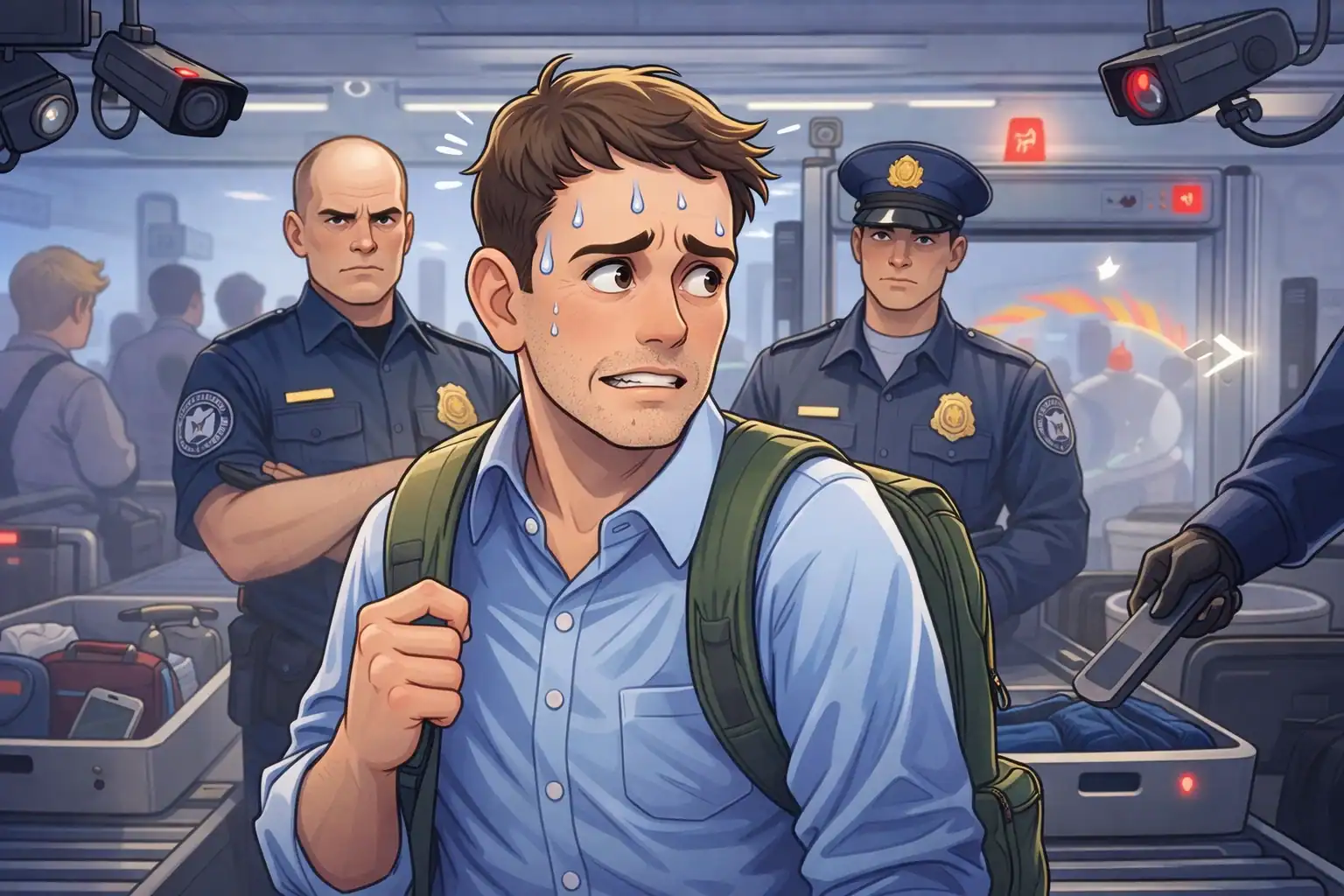
Your heart rate ticks up the moment you join the line. You start mentally inventorying your bag. Did you pack anything weird? Is that old Swiss Army knife still floating around in the bottom pocket? You replay the morning — did I leave something? And then, out of nowhere, a wave of guilt washes over you. For absolutely nothing. You haven’t done a single thing wrong, but somehow, walking toward that gray conveyor belt feels like walking into a principal’s office.
Why does a routine security check feel like an interrogation?
That feeling is real. And it’s almost universal. Ask almost anyone who’s passed through an airport security line — whether it’s a seasoned business traveler or someone taking their first international flight — and they’ll tell you the same thing. There’s something about that moment. The fluorescent lights. The uniformed agents. The slow shuffle forward. Even when you’ve packed perfectly, followed every rule, and remembered to leave your water bottle at home this time, something in your gut still tightens.
Table of Contents
Why Airport Security Causes Anxiety for So Many People
Airport security anxiety isn’t a personal quirk. It’s one of the most consistently reported sources of travel stress across cultures, age groups, and experience levels. People who fly every week still feel it. People who’ve never had a single issue at a checkpoint still feel it. The nervousness at airport security shows up reliably, regardless of guilt or innocence, experience or inexperience.
Part of what makes this so interesting is that the anxiety exists in a context where, objectively, almost nothing bad is going to happen to most travelers. You know the rules. You packed your bag. And yet, the moment you approach that checkpoint, something shifts.
Airport security stress sits at the intersection of several deeply human psychological triggers — authority, surveillance, time pressure, social judgment, and the brain’s ancient threat-detection wiring. Understanding each of these doesn’t just satisfy curiosity. It actually helps. Because once you understand why the anxiety fires up, it becomes a lot easier to turn the volume down.
Why Airport Security Triggers Authority Bias and Power Imbalance
Here’s something worth sitting with for a second. A person in a uniform, standing behind a table, with the power to slow you down or pull you aside — that combination does something to most human brains that no amount of rational thought can easily override.
Psychologists call it authority bias. We’re wired, from early childhood, to defer to perceived authority figures. The badge, the uniform, the official posture — they all signal “this person has power over me.” And when power is unevenly distributed, our nervous system notices. It doesn’t matter that the TSA agent is just doing their job and almost certainly doesn’t have a strong opinion about you. Your brain reads the visual cues and responds accordingly.
There’s also an evolutionary piece to this. For most of human history, someone in a position of physical and social dominance could genuinely change your fate. A tribal leader, a soldier, a guard. When those figures assessed you, the stakes were real. Your body learned to take that seriously. Fast forward a few thousand years, and your prefrontal cortex knows you’re just catching a flight to visit family. But your amygdala? It’s running much older software.
Body posture amplifies the whole thing. Security agents stand upright, rarely smile, and make direct eye contact — all dominant social cues. You, meanwhile, are shuffling forward with your shoes off, arms slightly raised, belongings scattered across three plastic bins. The physical asymmetry is almost comically loaded. You are, quite literally, in a submissive posture while someone in authority looks you over.
This dynamic is a significant driver of security line anxiety, and it activates whether you’re aware of it or not.
Why Innocent People Feel Guilty at Airport Security
Here’s the thing about being falsely accused of something — you don’t actually have to be accused for the fear of it to kick in.
Just the possibility that someone might think you’ve done something wrong is enough to trigger a stress response. This is partly because humans are deeply social creatures. Our sense of safety has never been purely physical. Reputation, social standing, being seen as trustworthy — these things mattered enormously to our ancestors and they still matter to our nervous systems today.
When you walk through a scanner at airport security, you’re placing yourself in a situation where someone with authority could, theoretically, publicly identify you as a problem. Even the fleeting thought of that outcome — the agent calling out your name, other passengers turning to look, the walk to the secondary screening area — activates the brain’s threat-detection system.
The amygdala, which handles emotional processing and fear responses, doesn’t distinguish especially well between real danger and perceived social danger. Being pulled aside at airport security won’t physically hurt you. But your brain may register it similarly to being publicly shamed or excluded from a group — which, for social mammals like us, historically carried serious survival consequences.
This is why airport security anxiety often manifests as guilt, even in people who have done absolutely nothing wrong. The brain isn’t being irrational. It’s being prehistoric. And the fear of false accusation — of being seen as guilty despite being innocent — is one of the oldest social fears humans carry.
Why Being Watched at Airport Security Increases Anxiety
Think about the last time you knew you were on camera. Did you walk a little differently? Maybe you were slightly more deliberate with your movements, a bit more careful with your expressions?
That’s not paranoia. That’s a well-documented psychological phenomenon. When people know they’re being observed — especially by authority figures — they become more self-conscious, more prone to self-monitoring, and paradoxically, more likely to make small errors or seem nervous even when they’re not.
Airport security environments are surveillance by design. Cameras everywhere. Officers watching. Automated systems scanning. Passengers watching each other. The public visibility of the whole thing adds a layer of performance pressure that most of us don’t encounter in daily life. You’re not just trying to get through the line — you’re aware that you’re being seen while you do it.
This creates what psychologists sometimes call self-monitoring overload. Your brain is simultaneously trying to manage your actual task — get the laptop out, take off your belt, find your boarding pass — while also managing the impression you’re making. That’s a significant cognitive load. And cognitive load combined with airport security stress is a reliable recipe for looking exactly the way you don’t want to look: flustered, uncertain, mildly suspicious.
The irony, of course, is that trying not to look nervous often makes you look more nervous. Anyone who’s ever tried too hard to “act natural” knows precisely what that feels like.
Why Long Airport Security Lines Increase Stress and Anxiety
There’s a reason the security line feels completely different when you have three hours to spare versus when your gate closes in forty minutes.
Time pressure is one of the most reliable triggers for cortisol — the body’s primary stress hormone. When we feel like we’re running out of time, the brain shifts into a scarcity mode. Resources feel limited. Decision-making gets less careful. Small uncertainties that would normally be manageable become genuine sources of airport security anxiety.
Add to that the fundamental unpredictability of security wait times, and you have a situation that seems almost engineered to produce stress. You don’t know how long the line will take. You don’t know if the person ahead of you will forget to take off their belt. You don’t know if your bag is about to get flagged for extra screening. That uncertainty — not knowing what’s coming or when — is genuinely hard for human brains to handle.
Psychologists refer to this as intolerance of uncertainty, and it’s one of the strongest predictors of anxiety in everyday situations. We can process bad news more easily than we can handle not knowing. A slow shuffle through a security line, with no clear end in sight and a departure time looming, hits several of these triggers simultaneously. Cortisol rises. Patience drops. And suddenly, every small delay feels enormous.
Why We Imagine Worst-Case Scenarios at Airport Security
Let’s say you’re completely calm as you approach security. Bag packed correctly. Nothing to worry about. And then, out of nowhere, a thought arrives: what if something is in my bag that I don’t know about?
Welcome to the availability heuristic at work.
The human brain is remarkably good at imagining low-probability disasters in vivid, convincing detail. This happens partly because news cycles and storytelling amplify unusual events — we hear about the person who accidentally packed something they shouldn’t have, the random bag search, the long secondary screening ordeal. These stories become mentally “available,” meaning they spring to mind easily when we’re in a similar situation.
So even though the actual probability of anything going wrong for a law-abiding traveler is close to zero, the brain generates worst-case scenarios with enough specificity that they feel plausible. At airport security, this can range from mild overthinking to genuine anxiety that persists for the entire time you’re in line.
What’s almost funny about it is that the more you try not to think about these scenarios, the more persistently they show up. Trying not to think about something activates the same mental pathways as thinking about it. Your brain doesn’t process negatives efficiently under stress. This loop is one of the most frustrating dimensions of security line anxiety — you know it’s irrational, and knowing that doesn’t help much.
Why TSA PreCheck Feels Less Stressful Than Regular Security
If you’ve used TSA PreCheck or any equivalent expedited security program, you may have noticed something: it’s not just faster. It feels different. Calmer. Less fraught.
This isn’t accidental. A significant part of what makes standard airport security stressful is uncertainty and the removal of control. PreCheck reduces both. You know exactly what to expect. You don’t have to remove your shoes. You don’t have to unpack your laptop. The process is predictable, and predictability is enormously soothing to a nervous system that’s been scanning for threats.
There’s also a subtle identity shift at play. Being pre-approved changes the psychological dynamic slightly. You’re not a person being assessed — you’re a person who has already passed assessment. The power asymmetry softens. You’re entering the line with a kind of prior clearance that, even symbolically, signals you’re fine, we already know. TSA anxiety tends to drop significantly in this context, not because the travelers are less nervous people by nature, but because several of the key anxiety triggers have been removed.
PreCheck essentially demonstrates, by contrast, exactly which elements of regular airport security are driving the stress. Strip away unpredictability and the sense of being evaluated, and most of the anxiety goes with it.
What Happens in the Brain During Airport Security Anxiety
Let’s get briefly into the neuroscience, without making this feel like a textbook.
When you approach airport security, your brain’s threat-detection network activates — even mildly. The amygdala, often described as the brain’s alarm system, picks up on environmental cues: authority figures, public surveillance, time pressure, the presence of uniformed officials. It sends signals that put the body on mild alert.
Your prefrontal cortex — the rational, reasoning part — knows perfectly well that you’re not in danger. But the amygdala is faster. It responds before your rational brain has a chance to weigh in. By the time your logical mind is reassuring you that everything is fine, your heart rate has already ticked up and your palms are already slightly damp.
The fight-or-flight response, which evolved to help us react to physical threats, doesn’t fully distinguish between “there’s a predator” and “there’s a uniformed authority figure who might think I’ve done something wrong.” It responds to both with a version of the same physiological readiness. The physical sensations — elevated heart rate, shallow breathing, heightened alertness — are essentially the same in both cases.
The key difference is that in real danger, you act. In the airport security line, you just stand there, trying to look normal, while your body runs a threat response with nowhere to go. That containment is part of what makes airport security stress feel so peculiar.
Why Humans Fear Public Judgment at Airport Security
To really understand nervous-at-airport-security feelings, you have to go back much further than airports. Much further than civilization, actually.
For most of human prehistory, being judged by dominant members of your group carried real survival stakes. Exile from the tribe wasn’t just uncomfortable — it was often fatal. Food, protection, shelter, reproduction — all of these depended on social belonging. Being seen as a threat, a troublemaker, or simply someone who didn’t fit the group’s norms could result in genuine exclusion.
This is why the fear of social judgment runs so deep. It isn’t a flaw in human psychology. It’s a feature that served a real purpose for a very long time. The problem is that this survival wiring doesn’t automatically recalibrate to modern contexts. At airport security, your brain runs the same basic calculations it would have in a tribal gathering where the chief was assessing your behavior. The stakes are completely different. The emotional response is not.
The fact that you haven’t done anything wrong is almost beside the point. The possibility of negative social judgment, from someone with authority, in a public space — that alone is enough to activate instincts that are tens of thousands of years old. Airport security anxiety, at its root, is the sound of ancient software running on a very modern problem.
How to Stay Calm at Airport Security and Reduce Anxiety
Knowing why it happens helps. But knowing how to manage it helps more.
The most immediately effective thing you can do in the moment is slow your breathing deliberately. Not dramatic deep breaths that draw attention — just a slightly extended exhale. Breathing out for longer than you breathe in activates the parasympathetic nervous system, which is the body’s “stand down” signal for the stress response. It works, and it works relatively quickly. Even in a busy security line.
Cognitive reframing is the other major tool. This means consciously redirecting your internal narrative from what if something goes wrong to something that reflects actual odds: I’ve done this before, I know what to expect, this will take about four minutes. It sounds almost too simple, but actively naming what you’re experiencing — “this is just my stress response activating in an unusual environment” — engages the prefrontal cortex and genuinely quiets the amygdala.
Reality testing works alongside this. Ask yourself honestly: what is the realistic probability that anything bad happens here? Not the catastrophic version your brain is narrating, but the statistically accurate one. For the vast majority of travelers, the answer is essentially zero. Saying that plainly to yourself, in your own head, interrupts the anxiety loop.
And if you travel regularly, pre-commitment thinking is worth building into your routine. Decide at home, not in the line, exactly what you’ll do and in what order. Laptop out first. Belt in the bag before you leave. Phone in your jacket pocket. Boarding pass already pulled up. The more automatic the process becomes, the less cognitive space it occupies — and the less room there is for airport security anxiety to fill.
The Thought Worth Leaving You With
There’s something quietly remarkable about the fact that millions of people, every single day, experience guilt they don’t deserve in response to a process they’ve done nothing to warrant. Nervous-at-airport-security feelings aren’t a sign of irrationality or weakness. They’re a sign of being human — deeply social, finely attuned to power and judgment, and carrying behavioral wiring that was written for a world that looked nothing like a terminal in Dallas or Dubai.
The security line is, in a strange way, a very pure collision between modern systems and ancient instincts. The system was designed for efficiency and threat detection. The instincts were designed for tribal survival. Neither of them particularly cares that you just want to get to your gate and find a decent sandwich.
Maybe that’s the most grounding thing you can remind yourself next time your heart rate jumps as you shuffle toward the conveyor belt: the airport security stress you’re feeling isn’t a sign that something is wrong with you. It’s a sign that you’re a completely normal human being, running completely normal software, in a situation your ancestors absolutely could not have prepared you for.
You’re fine. You’ve always been fine. The belt goes on the conveyor.
Frequently Asked Questions
-
Why do I feel nervous at airport security?
Feeling nervous at airport security is an almost universal experience, and it has very little to do with guilt. The combination of authority figures, public surveillance, time pressure, and the fear of social judgment activates the brain’s threat-detection system — even when there’s no real threat present. Your amygdala responds to the environment, not to what you’ve actually done.
-
Is it normal to feel anxious at TSA?
Completely normal. TSA anxiety is reported across all kinds of travelers — frequent fliers, first-timers, people who’ve never had a single issue at security. The conditions of a standard security checkpoint hit several deep psychological triggers simultaneously, and the stress response that follows is a normal human reaction, not evidence of anything unusual about you.
-
Why do innocent people feel guilty at security checks?
The brain doesn’t need an actual accusation to trigger guilt anxiety — the mere possibility of being judged negatively by an authority figure in a public space is enough. This goes back to deep social wiring around reputation and group belonging. Being seen as suspicious, even briefly, registers as a social threat, and that threat activates a stress response regardless of whether you’ve done anything wrong.
-
Can airport security trigger social anxiety?
Yes, and fairly directly. The airport security environment combines several core social anxiety triggers: being observed by authority figures, performing under scrutiny, public exposure, and uncertainty about outcomes. For people who already experience social anxiety, security line anxiety can feel significantly more intense. The good news is that the same techniques that help with general social anxiety — controlled breathing, cognitive reframing, grounding in realistic probability — also help here.
-
How can I stop overthinking at airport security?
A few things consistently help. First, make as much of the process automatic as possible before you arrive — know your routine and stick to it. Second, slow your exhale deliberately while waiting; this activates your parasympathetic nervous system and lowers the physical arousal. Third, reality-test the thoughts: name the actual, honest odds that anything goes wrong. And finally, remind yourself that the nervousness is a normal physiological response to an unusual environment, not a signal that something is actually wrong. Naming the anxiety, rather than fighting it, tends to reduce its intensity faster than almost anything else.