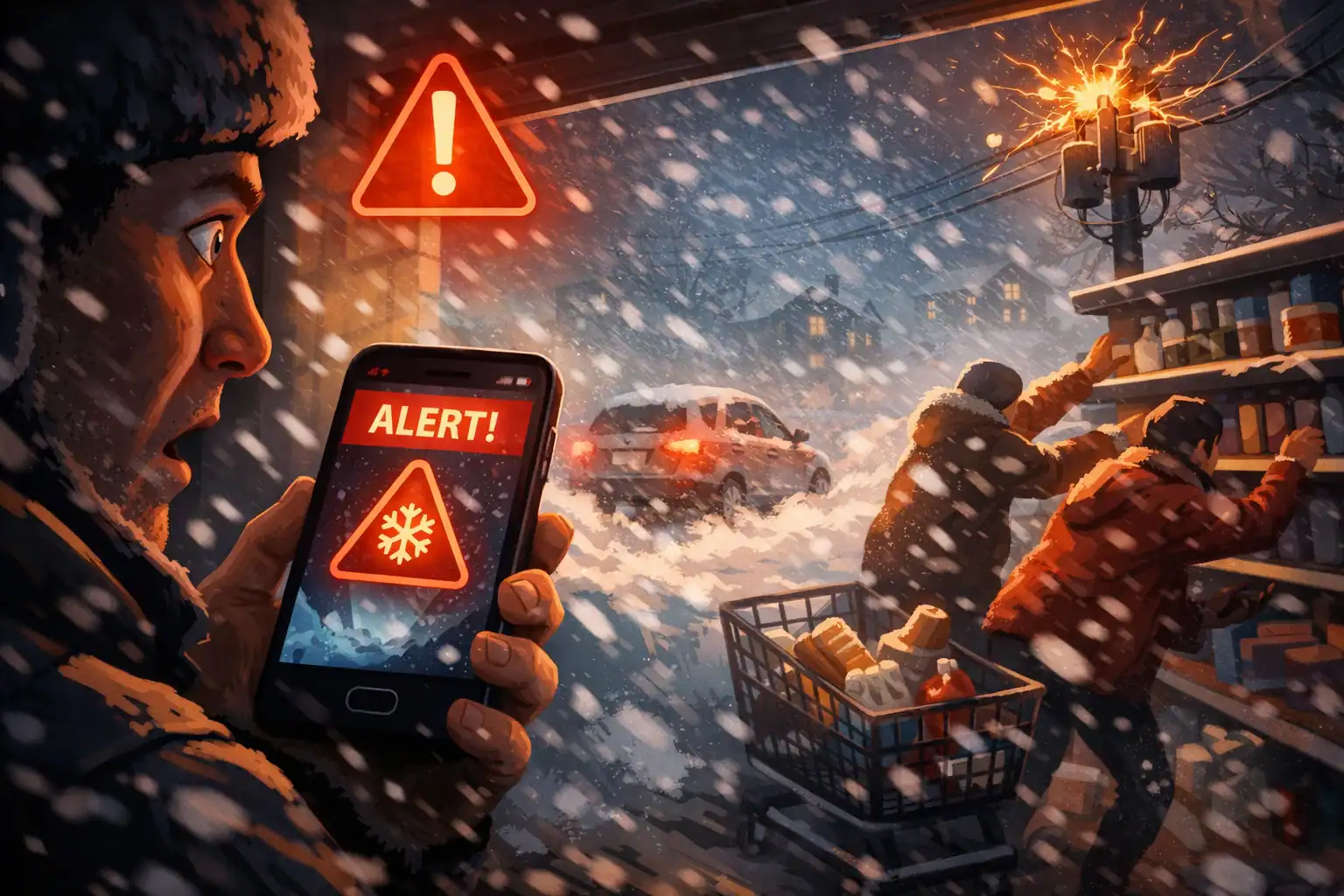
There’s a specific sound your phone makes. You know the one. That jarring, buzzing alert that cuts through whatever you’re doing — a meeting, dinner, sleep — and makes your stomach drop before you’ve even read a word. You look at the screen. “BLIZZARD WARNING.” And somehow, within the next twenty minutes, you’re mentally calculating how much bread you have at home.
That’s not an accident. That’s your brain doing exactly what it was built to do.
But here’s the thing worth thinking about: a storm hasn’t hit yet. The sky outside might still be clear. And yet the grocery store three miles away is already turning into a scene from a disaster film. What is actually happening inside us when a weather alert comes through? And why does snow, specifically, make people behave in ways that a thunderstorm or a heat wave usually doesn’t?
Table of Contents
What Is a Blizzard Warning?
Before getting into the psychology, a little context helps. A blizzard warning isn’t just “it’s going to snow a lot.” The National Weather Service issues one when conditions meet specific thresholds — sustained winds or gusts over 35 mph, significant snowfall, and visibility dropping to under a quarter mile, all lasting at least three hours. It’s the combination that makes it dangerous. Snow alone is manageable. Snow plus wind plus near-zero visibility is something different.
Blizzard conditions can make roads impassable within minutes, strand drivers, knock out power, and shut down entire cities. So the fear has a legitimate foundation. That part matters. Keep it in mind, because later we’ll look at where the legitimate concern ends and where something more irrational takes over.
Why Blizzard Warnings Trigger Fear in the Brain

Here’s a basic fact about human beings that explains a lot of modern behavior: our brains are running very old software.
For most of human history, a sudden environmental signal — a sound, a shift in the air, a change in the sky — meant something was coming for you. Predators. Fire. Floods. The people who reacted fast survived. The people who stopped to evaluate calmly sometimes didn’t. So evolution built us to treat sudden signals as danger signals, full stop.
When your phone screams that alert sound, your amygdala — the part of your brain that handles threat detection — fires before your prefrontal cortex (the reasoning part) even gets involved. Fear first, logic second. This isn’t a flaw. It’s a feature that kept your ancestors alive. The problem is that it doesn’t distinguish between a lion in the grass and a weather notification.
The psychologist Daniel Goleman, who popularized the concept of emotional intelligence, described this as “amygdala hijack” — a moment when your emotional brain takes the wheel and your rational brain is essentially a passenger trying to explain things calmly from the back seat while nobody’s listening. Goleman’s work, built on earlier neuroscience research by Joseph LeDoux, showed that emotional responses to perceived threats follow a neural shortcut that deliberately bypasses slower, deliberate reasoning. It’s fast by design.
Risk perception compounds this. People are notoriously bad at assessing risk accurately, especially under emotional arousal. We overestimate risks that are vivid, sudden, and feel uncontrollable. A blizzard hits all three. You can picture it. It arrived with an alert sound. And you can’t stop it.
The Psychology of Uncertainty — Why “How Bad Will It Be?” Is the Scariest Question
Known danger is, in a strange way, easier to handle than unknown danger. If someone tells you the storm will drop exactly 8 inches of snow and roads will reopen by noon, your brain can make a plan. Grocery run tonight, stay home tomorrow, done.
But blizzard forecasts don’t work like that. Projected snowfall totals have ranges. Storm tracks shift. “Up to 18 inches” sounds very different from “exactly 18 inches,” even if the expected outcome is similar. That gap — the space between what we know and what we don’t — is where panic lives.
This has been studied carefully. Researchers Amos Tversky and Daniel Kahneman, whose work on cognitive biases essentially founded the field of behavioral economics, demonstrated that people consistently make worse decisions under ambiguous conditions than under clearly defined risk. Their research showed that uncertainty — not danger itself — produces the most pronounced stress responses and the most irrational behavior. Kahneman later described this in his landmark book Thinking, Fast and Slow, explaining how the brain’s “System 1” (fast, emotional, automatic) dominates during ambiguous threat scenarios, often crowding out the slower, more measured reasoning we’d ideally want to apply.
People fear uncertainty more than a known bad outcome. It’s why waiting for a diagnosis is often worse than getting a difficult one. And it’s why the hours between “storm is coming” and “storm is here” are peak anxiety time.
Add to that the specific fears a blizzard raises. Will the power go out? For how long? Will the roads be closed before I can get back from work? What if someone needs medical help and ambulances can’t get through? These aren’t irrational fears — they’re real possibilities. But they stack on top of each other fast, and the brain doesn’t sort them neatly. It just registers: threat level rising.
Why Panic Buying Happens Before a Blizzard
The milk and bread thing is real, and it’s genuinely fascinating.
In the American South particularly, where snowstorms are less frequent and infrastructure is less prepared, stores sell out of milk, bread, and eggs within hours of a winter storm warning. The joke practically writes itself — people are apparently planning to make French toast while snowed in. But the behavior isn’t as absurd as it looks.
Several psychological forces converge at once.
Scarcity effect is the first. The moment something might not be available, it becomes more valuable in your mind. You weren’t thinking about bread at all. Now that you might not be able to get it, bread feels essential. This aligns with what behavioral economists call “loss aversion” — another concept from Kahneman and Tversky’s research — which found that people feel the pain of losing something roughly twice as strongly as the pleasure of gaining the same thing. The prospect of not having food feels worse than the satisfaction of having it would feel good.
Then there’s herd behavior. You see other people filling their carts. Social proof kicks in — if everyone around you is stocking up, your brain reads that as a signal that stocking up is the correct behavior. You don’t want to be the one person who didn’t get the memo.
Fear of being underprepared is its own separate driver. It’s not just about the food. It’s about not wanting to sit in your house three days from now, cold and hungry, thinking “I should have gone to the store.” The act of buying supplies is also the act of doing something, which temporarily quiets the anxiety of feeling powerless.
And powerlessness is really what panic buying is about. The storm is coming regardless of what you do. You can’t stop it. But you can buy things. So you buy things.
The Media Amplification Effect
Weather forecasting has gotten dramatically better over the past few decades. Storm tracks that were educated guesses in the 1980s can now be predicted with real precision days in advance. That’s genuinely useful. But there’s a side effect: the warning window is longer, which means the coverage window is longer, which means more hours of “MONSTER STORM APPROACHING” graphics and crawling text at the bottom of your screen.
Cable news and local weather coverage have an incentive structure that doesn’t always align with calm, proportional information sharing. Dramatic language gets attention. “Life-threatening blizzard conditions” makes people watch. “Significant winter storm” does not trend on social media.
Push notifications have made this worse in a specific way. Weather apps send alerts constantly now, and each one arrives with that same jarring sound, creating a kind of Pavlovian anxiety response. Multiple alerts over multiple days about the same storm have a cumulative effect — each one refreshes the fear even when no new information has actually changed.
Social media amplifies everything further. Emotional contagion — a documented psychological phenomenon, studied extensively by researchers including Elaine Hatfield and John Cacioppo — describes how emotions spread through social networks much the way viruses do. One anxious post about the storm gets shared, commented on, reacted to, and each interaction spreads the anxiety a little further. A 2014 study published in PNAS by researchers at Facebook and Cornell University found that emotional states could be transferred to others through social media feeds alone, even without direct interaction. By the time the storm actually arrives, a significant portion of the population has been marinating in storm-related fear content for 48 to 72 hours straight.
That’s a long time to be scared of weather.
Why Snow Paralyzes Cities — and the Mind
Rain is wet and annoying. Snow is something else. There’s a reason blizzards carry a particular psychological weight that other storms don’t.
Visibility is part of it. Whiteout conditions are genuinely disorienting — they remove the visual information you rely on to navigate, to drive, to judge distance. That sensory disruption feels threatening in a very primal way. Rain makes things gray. Snow makes things disappear.
There’s also the physical sensation of being trapped. Roads don’t just become dangerous in a blizzard; they become impassable. You can’t leave. For most of human history, the inability to move meant you were stuck somewhere with limited resources, dependent on what you had on hand. That feeling of potential confinement activates something deep.
The 1993 “Storm of the Century” is a useful example here. It affected over 100 million people across the eastern United States — from Alabama to Maine — and remains one of the most expansive weather events in recorded American history. More than 300 people died, millions lost power, and airports from Atlanta to Boston shut down simultaneously. What made it psychologically significant, beyond the scale, was how completely it paralyzed the sense of normalcy across such a vast area at once. People who had lived through plenty of snowstorms said this one felt different — not just because of the snow, but because of how total the shutdown was. Everything stopped.
Cities make all of this worse because urban life is built on constant, reliable access. Groceries arrive daily. Power stays on. Public transit runs. Blizzards threaten all of that simultaneously, and cities have relatively little redundancy built in. When a major snowstorm hits New York or Chicago — or, more dramatically, when winter storms hit cities that rarely see snow, like the February 2021 storm that left large parts of Texas without power for days, contributing to an estimated 246 deaths — it doesn’t just slow things down. It exposes how fragile the infrastructure underneath daily life actually is.
People sense that fragility. And sensing it is unsettling in a way that’s hard to articulate but impossible to ignore.
Are We Overreacting?
Worth asking honestly. Because sometimes the answer is yes, and sometimes no, and it depends on factors most people don’t stop to consider.
Blizzard warnings have prevented a significant number of deaths by prompting people to stay off roads, stock supplies, and check on vulnerable neighbors. The warnings work. Preparedness genuinely reduces harm. On that level, some degree of urgency in response to a warning is rational and appropriate.
But the scale of the panic sometimes exceeds the actual danger by a meaningful margin. Storms forecast to be historic sometimes deliver six inches of manageable snow. Supply shelves cleared out before the storm are restocked within days. Cities that shut down for 48 hours are usually running again by Thursday.
The gap between “how scared we got” and “how bad it actually was” isn’t random. It’s driven by the psychological and media factors already covered. Fear isn’t calibrated to outcomes. It’s calibrated to threat signals. And in the modern information environment, the signal is always louder than the storm.
That said — the blizzards that are genuinely catastrophic are exactly why the warnings exist. The 1993 Storm of the Century. The 1978 Great Blizzard that killed over 70 people in Ohio alone. The 2021 Texas freeze. Those events were as bad as feared, or worse. Dismissing the warnings because the last few weren’t that bad is its own cognitive error — recency bias doing its thing, quietly convincing you that the pattern of the recent past is the permanent pattern of the future.
How to Stay Rational During a Blizzard Warning
Rational doesn’t mean calm. It means making decisions based on actual information rather than fear signals.
Prepare gradually, not frantically. If a storm is three days out, you have time. You don’t need to be at the grocery store at 6am the morning of the warning. Make a reasonable list of things you’d actually use over a few days stuck at home, and pick them up without urgency.
Check official sources directly. The National Weather Service website gives raw forecasts without dramatic framing. Local emergency management agencies post practical guidance. These are meaningfully different from weather app push notifications, which are engineered to grab attention and often succeed at that more than at informing.
Notice herd behavior when you’re in it. If you find yourself piling things into a cart because everyone else is, stop for a second and ask what you actually need. You might genuinely need it. Or you might be riding a social wave that has more to do with collective anxiety than personal necessity.
Have a basic winter readiness setup year-round: flashlights, a few days of non-perishable food, water, phone chargers. When you already have the basics covered, a blizzard warning stops being an emergency that requires immediate action and starts being useful information you can respond to calmly — without the sprint to the store.
The goal isn’t to not care about the warning. The goal is to respond to it rather than react to it.
The Deeper Truth Under All of It
When you pull back far enough, blizzard panic isn’t really about snow. Snow is just the trigger.
What the warning actually activates is a set of much older, deeper anxieties: about losing control, about being unprepared, about the systems we depend on quietly failing us, about uncertainty that no amount of refreshing a weather app will resolve. The storm becomes a container for all of that at once. And in a world where most people have very little practice sitting with uncertainty — where we can usually find out anything instantly, get anything delivered within hours, control our environments to an extraordinary degree — the sudden reminder that a weather system doesn’t care about any of that is genuinely jarring.
The blizzard holds up a mirror. Modern life is extraordinarily comfortable and extraordinarily fragile at the same time. We’ve built systems that work beautifully right up until they don’t. And when something as ancient as winter reminds us of that, we go buy bread.
Maybe what the panic is really telling us — and this is worth sitting with — is that control is mostly an illusion we’ve agreed not to examine too closely. Every so often, the weather makes that impossible to ignore.
FAQs
-
Why do people buy milk before a snowstorm?
It’s a mix of scarcity psychology, loss aversion, and herd behavior — all converging at once. Milk, bread, and eggs are comfort staples. Buying them is also a way of doing something when you feel powerless against an uncontrollable event.
-
Why do weather alerts cause anxiety?
Sudden alerts trigger the brain’s amygdala — the threat-detection center — before rational analysis has a chance to kick in. Stress hormones release, and you’re in a low-grade fight-or-flight state before you’ve finished reading the notification.
-
Is panic buying rational during severe weather?
Partly. Having a few days of basic supplies on hand is genuinely sensible preparation. Clearing store shelves in a frenzy because everyone else is doing it is a different thing — anxiety-driven behavior dressed up as practicality.
-
How dangerous are blizzards compared to other storms?
Blizzards kill fewer people in absolute numbers than hurricanes, but they affect much larger geographic areas simultaneously and for longer durations. Their danger comes from the combination of cold, wind, duration, and infrastructure shutdown — not from a single catastrophic moment, but from an extended, grinding pressure on systems and people alike.