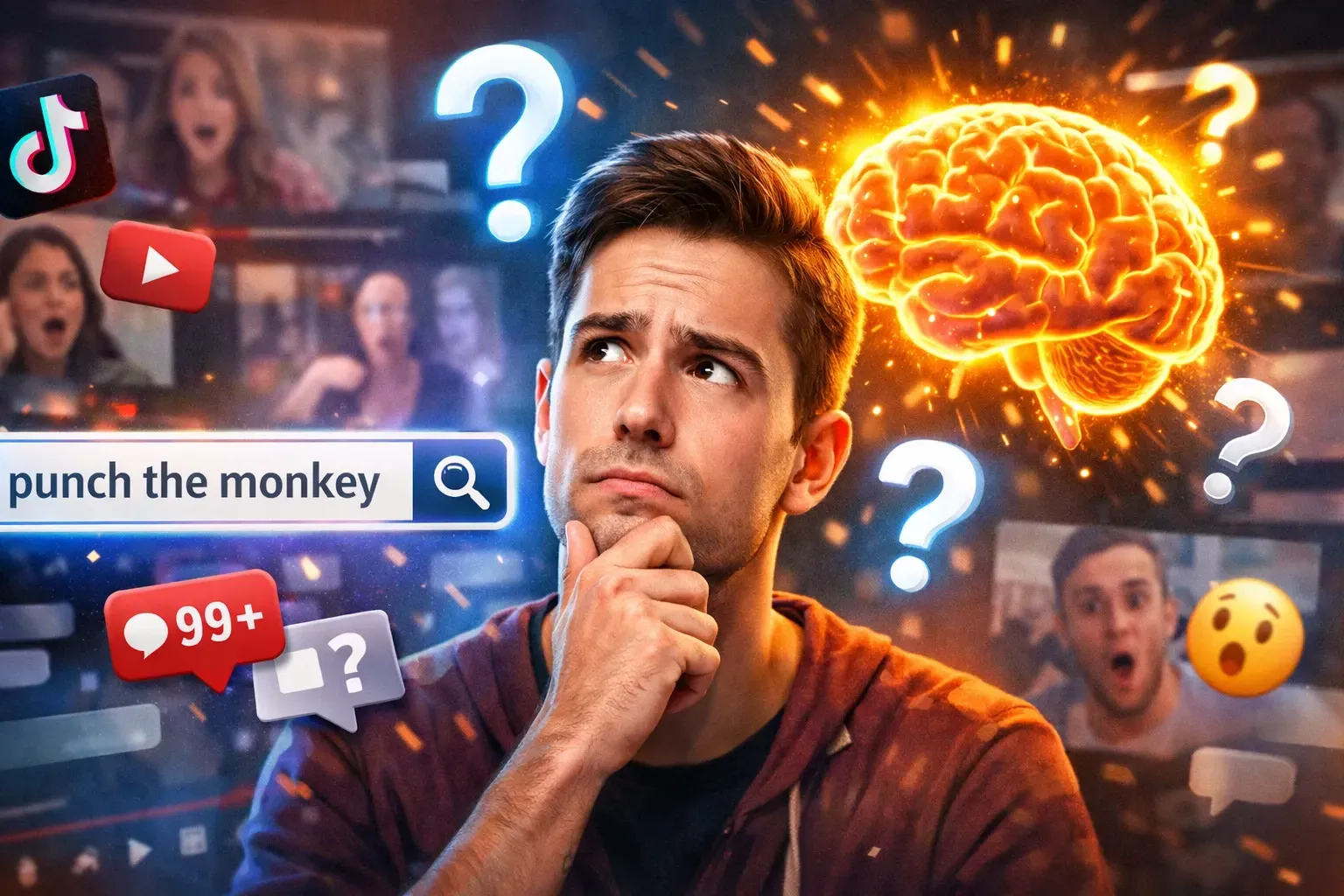
You didn’t search for it because you understood it. You searched for it because you didn’t.
That’s the whole trick, really. Somewhere between a Tuesday afternoon scroll and a vague sense of social unease, millions of Americans typed a strange little phrase into Google — and the search bar lit up. No news event triggered it. No celebrity said it on live television. It just… appeared. And once it appeared, it spread.
That’s the part worth examining. Not what the phrase means, but why a phrase that means almost nothing to most people can dominate search trends, fill comment sections, and make people feel genuinely anxious about being out of the loop.
Table of Contents
The Search Spike Nobody Saw Coming
Google Trends doesn’t lie, even when the data is confusing. “Punch the Monkey” registered a sharp search surge in the United States — the kind of near-vertical climb on the interest graph that usually signals breaking news or a celebrity scandal. Neither applied here. Interest spiked notably in early 2025, with search volume jumping dramatically within a 24-to-48-hour window before beginning to plateau. According to trend trackers, engagement was highest in the South and Midwest, though it spread nationally within days.
What made this particular spike unusual was the absence of a clear origin point. There was no single viral video that started it, no news anchor who accidentally said it on air. It just crossed some invisible threshold of collective awareness and took off.
That’s the thing about random phrases. They don’t need context to go viral. Sometimes they go viral because there’s no context. People see something trending, don’t understand it, and their first instinct isn’t to ignore it. Their first instinct is to find out why everyone else already seems to know.
Which raises the real question: why do we search for things we don’t understand, especially when those things seem slightly strange or even mildly transgressive?
What Does “Punch the Monkey” Actually Mean?
Honestly? It depends on who you ask — and that ambiguity is a large part of why it spread.
Older internet users may recognize the phrase from early 2000s flash game banner ads, those obnoxious animated ads that plastered themselves across every free website and dared you to “punch the monkey” with your cursor to win a prize. They were everywhere. They were annoying. And apparently, they lodged themselves into the cultural memory of an entire generation.
The current trending version is murkier. Some corners of TikTok use it as slang. Others treat it as a reaction phrase. A few people seem to be referencing something entirely different. There’s no clean consensus, which — as you’ll see — is precisely the point. Phrases that resist easy definition travel further than phrases that explain themselves on first contact.
So if you came here expecting a neat answer, the honest response is: it means different things in different contexts, and the internet hasn’t agreed on one yet. That unresolved quality is exactly what keeps people searching.
The Curiosity Gap: The Science Behind “Wait, What?”
Back in the 1990s, a behavioral economist named George Loewenstein put forward something called the Information Gap Theory. The short version: when we sense that there’s something we should know but don’t, it creates genuine cognitive discomfort. Not metaphorical discomfort. Actual mental tension that the brain wants to resolve.
He called it the curiosity gap — the space between what you know and what you feel like you’re missing. And here’s the important part: the gap doesn’t need to be large to be compelling. It just needs to exist.
“Punch the Monkey” is almost perfectly engineered to create this gap, probably by accident. It sounds like it means something. It sounds like something you might have heard before, maybe in a different context, or maybe you’re just forgetting it. That ambiguity is doing a lot of heavy lifting. The brain doesn’t like loose ends, and an unexplained trending phrase is about as loose as loose ends get.
So people search. Not because they’re particularly interested in monkeys or punching — but because uncertainty feels bad, and clicking “search” feels like a solution.
Ambiguity Plus a Hint of Edge: A Viral Formula
Let’s break down what makes this particular phrase effective at grabbing attention.
The word “punch” is aggressive. Not violently alarming, but enough to register as slightly outside normal conversation. The word “monkey” is unexpected in combination with it — primates carry their own layer of cultural complexity depending on context, which means the brain flags it as potentially sensitive. Together, the phrase sits in a strange middle zone: not obviously offensive, not obviously innocent. Just slightly off.
That’s where salience bias comes in. The brain is wired to pay extra attention to things that feel socially risky or out of place. It’s an old instinct. In a physical world, something slightly wrong in your environment could signal danger. In a digital world, that same instinct fires when we encounter something we can’t immediately categorize.
Negativity bias compounds this. Humans are more alert to potentially negative information than neutral or positive information. A phrase that sounds vaguely aggressive will get processed faster and held longer in attention than, say, “pet the poodle.” The brain is essentially asking: should I be worried about this? Does this mean something I need to know?
Usually the answer is no. But by the time the brain figures that out, you’ve already opened a new tab.
Social Contagion and the TikTok Comment Loop
Here’s where it gets interesting from a social dynamics perspective.
TikTok — and to a slightly lesser degree, Twitter/X — runs on reaction. Someone posts a confused comment (“wait what does this even mean??”), and that comment gets more engagement than the original content. Now the algorithm sees engagement. It boosts the content. More people see it, more people are confused, more comments pour in asking what it means. Nobody’s explaining it clearly because nobody actually knows, and the loop feeds itself.
This is emotional contagion working in real time. You don’t need to feel an emotion firsthand to catch it — you just need to see enough people expressing it. When a comment section is full of confusion and mild bewilderment, that bewilderment is contagious. You start to feel it too, even if you stumbled across the video entirely by accident.
Social proof layers on top of this. If thousands of people are asking about something, your brain quietly files that as evidence that the thing matters. It might not matter at all. But the sheer number of people engaging with it creates the perception of significance. That perception drives more searches. More searches feed the trend. The trend validates the perception.
The phrase doesn’t need to mean anything meaningful. It just needs to seem like it does.
Why Algorithms Are Built for Confusion
This is the part that the platforms would probably prefer you didn’t think about too hard.
Social media algorithms are not designed to spread clarity. They’re designed to spread engagement. And confusion — genuine, unresolved, “I don’t get this” confusion — drives some of the highest engagement rates of any content type. Comments asking for explanations. Quote tweets expressing bewilderment. Duet videos of people reacting with raised eyebrows. All of that counts as engagement. All of it gets rewarded.
The algorithm doesn’t know the difference between someone sharing something because it’s meaningful and someone sharing something because they can’t figure out what it is. A click is a click. A comment is a comment. So platforms end up systematically amplifying the things that leave people most unresolved — the phrases that don’t quite explain themselves, the trends that feel like inside jokes you weren’t invited to.
There’s a dark little irony in there somewhere. The internet was supposed to be an information superhighway. It turns out confusion travels faster than clarity on that highway, and the toll booths are all set up to benefit from the traffic.
Why We Can’t Just Scroll Past
The psychological underpinning here goes deeper than curiosity. It touches something fairly fundamental about how humans operate in social groups.
FOMO — fear of missing out — is well-documented and overused as a term, but it’s pointing at something real. Knowing the shared references of your social group isn’t just pleasant. It’s historically been a signal of belonging. Being out of the loop on what people are talking about triggers a mild version of social exclusion anxiety. Not dramatically, not consciously — just a small, nagging sense that everyone else is in on something you’re not.
With internet slang and viral phrases, this is amplified. Language is a social signal. Knowing what “punch the monkey” refers to — or whatever the phrase of the week happens to be — functions as a kind of cultural currency. Not knowing it feels, briefly, like a status gap. And humans will do a lot to close status gaps, even small ones. Including spending twenty minutes down a search rabbit hole trying to figure out what a mildly weird phrase is actually referring to.
Evolutionary psychology would frame this as a remnant of group survival instincts. Understanding what your group is doing and talking about kept you included. Exclusion was genuinely dangerous in environments where cooperation meant survival. The modern version of that instinct fires when you see a trending phrase and feel that flicker of “wait, am I the only one who doesn’t know this?”
You’re probably not. That’s the quiet punchline most of these viral moments share — the majority of people searching are also confused, which means the trend is mostly built on collective confusion masquerading as collective knowledge.
The Bigger Picture: The Internet Rewards Uncertainty
Here’s what this whole episode actually reveals about how information — or the illusion of information — moves online.
The internet doesn’t spread understanding efficiently. It spreads the feeling that understanding exists somewhere, just slightly out of reach. Viral phrases, ambiguous memes, unexplained trends — these aren’t bugs in the system. They’re features, in the sense that they reliably generate the behavior that platforms are optimized around.
A phrase that instantly made sense to everyone would be shared, appreciated, and forgotten. A phrase that nobody quite understands will be searched, discussed, argued over, dunked on, and eventually explained in seventeen different ways — each explanation generating its own wave of engagement.
Clarity is a destination. Confusion is a journey. And the algorithm loves a long journey.
But here’s the practical takeaway, because awareness without application doesn’t do much: the next time you feel that compulsive pull to search something trending, pause for a second. Ask yourself whether you genuinely want the information, or whether you’re just responding to the discomfort of not knowing. That distinction matters more than it sounds. Most viral phrases evaporate within a week. The attention you spent chasing them doesn’t come back.
Understanding how these curiosity loops work — the information gap, the salience bias, the social proof spiral — gives you a small but real advantage. You can still follow trends. You can still be curious. But you can do it with slightly more awareness of who benefits when you click, and who’s designed the system to make sure you do.
That’s not a comfortable thought if you like to believe your attention is mostly spent on things that matter. But it’s a useful one. Loewenstein mapped the gap between knowing and not knowing. The internet found a way to monetize it.
Frequently Asked Questions
What does “Punch the Monkey” mean?
The phrase doesn’t have a single clear or universally agreed-upon meaning, which is largely why it spread. Its ambiguity — combined with its slightly edgy phrasing — made it ideal viral fodder. Some older internet users may recognize it from early 2000s flash game banner ads. The current trend is more about the phrase’s psychological pull than any specific definition.
Why do random phrases suddenly trend on Google?
Usually because a small burst of curiosity triggers algorithmic amplification. Once enough people search or engage with something, platforms boost its visibility, which drives more searches. The trend becomes self-reinforcing — confusion creates engagement, engagement creates visibility, visibility creates more confusion.
How do TikTok trends affect search behavior?
Significantly. TikTok’s comment sections frequently function as curiosity engines — people see something confusing, post their confusion publicly, and that post gets engagement. Viewers who encounter those confused reactions then search the phrase independently, spiking Google Trends data. The two platforms feed each other in real time.
Why are people so curious about strange or unclear phrases?
It’s a combination of the curiosity gap (cognitive discomfort from incomplete information), social belonging instinct (not wanting to miss shared cultural references), and negativity bias (the brain pays extra attention to things that seem slightly off or edgy). Together, these create a near-compulsive drive to search for meaning — even when the meaning turns out to be minimal.
How long do these viral phrase trends usually last?
Most follow a predictable arc: a sharp spike over 24–72 hours, a brief plateau as explanations circulate, then a steady decline within one to two weeks. A small number get absorbed into ongoing slang. The majority are forgotten almost as quickly as they appeared — which makes the attention spent chasing them feel, in retrospect, a little disproportionate to their actual significance.