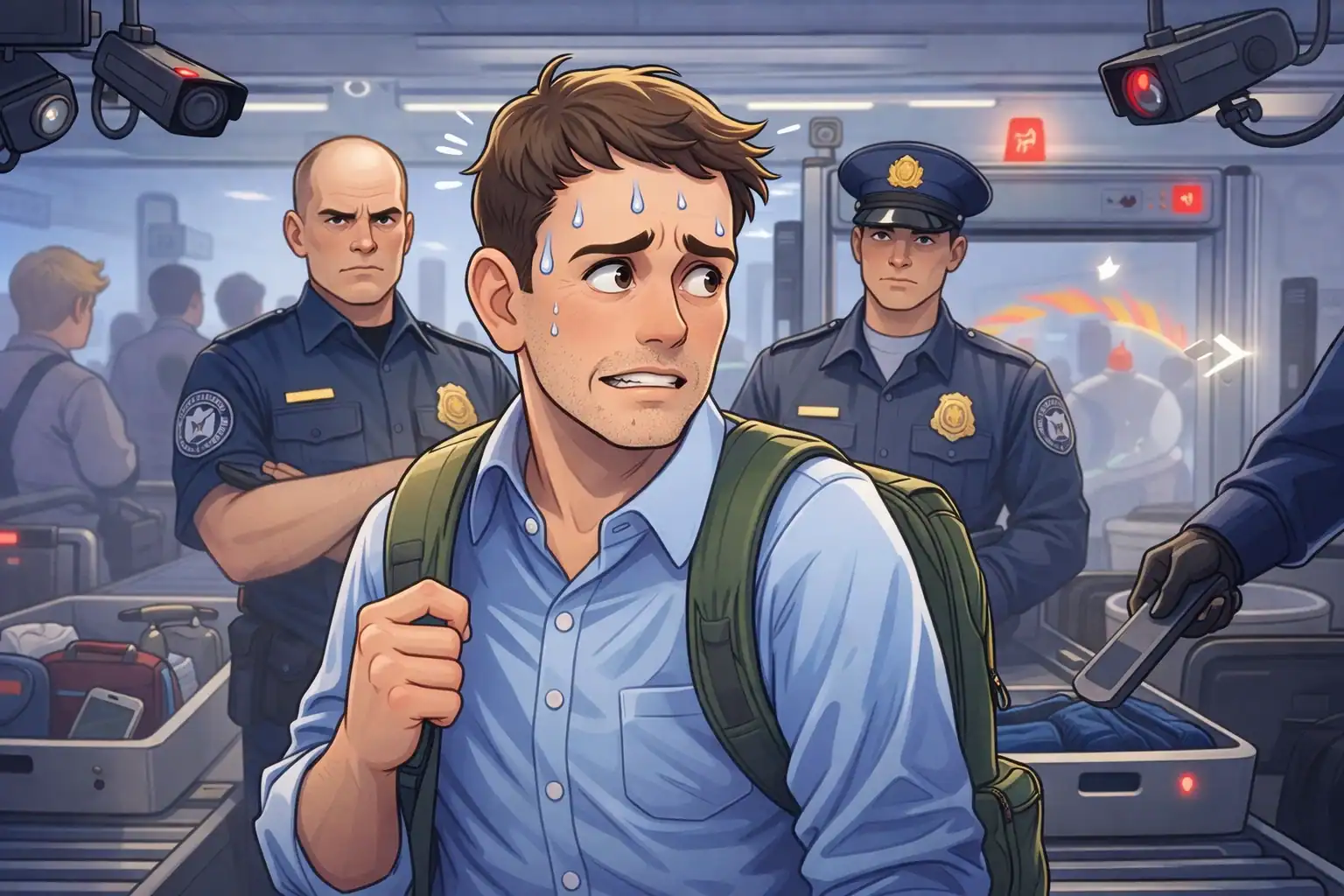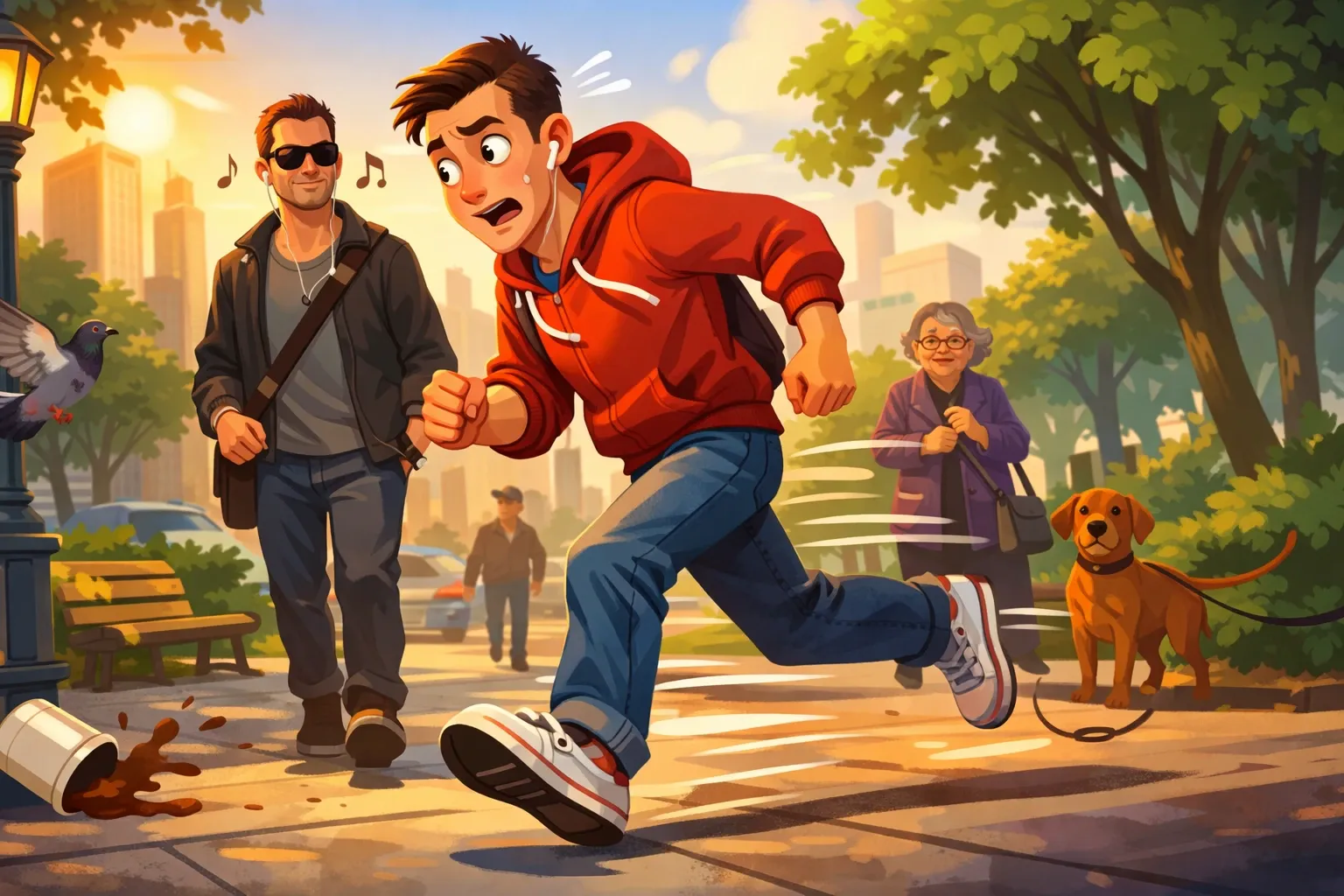
You’re walking. Everything is fine. The pace is comfortable, the thoughts are somewhere between what to eat for dinner and absolutely nothing. Then — footsteps. Behind you. Closer than you’d like.
Suddenly, without any conscious decision, your legs are moving faster. Your arms swing with purpose. You are no longer a person on a casual walk. You are, for reasons you can’t fully explain, a person going somewhere. Efficiently. Immediately.
You don’t want to be caught. You don’t want to look slow. And the strangest part? You didn’t even decide any of this. Your body just… went.
So why does a perfectly normal walk turn into a low-speed race the moment someone appears behind you? The answer lives somewhere between ancient wiring and very modern social anxiety — and it says more about human psychology than most of us expect.
Table of Contents
Why Being Followed Triggers Our Survival Instincts
Here’s the uncomfortable truth: your brain never fully evolved past the assumption that something behind you might be a threat.
Thousands of years ago, that made sense. Whatever was approaching from behind wasn’t announcing itself. Predators didn’t walk up beside you and politely introduce themselves. They came from angles you couldn’t see. So the brain developed a system — still very much active — that treats the space behind you as the one zone you can’t fully monitor. And things you can’t monitor make you nervous.
This is called peripheral awareness, and it operates even when you’re not consciously paying attention. The moment someone enters that blind zone — behind you, slightly off to the side — your threat detection flickers on. Not in a dramatic, heart-pounding way. Just a low hum. A quiet signal that says: something changed. Pay attention.
The reflex is automatic. You don’t choose it, the same way you don’t choose to flinch when someone throws something at your face. It just fires.
The footsteps trigger it. The rhythm of steps behind you is one of the most evolutionarily loaded sounds a human can hear. Your brain picks it up, measures the pace, calculates the distance, and starts running a background threat assessment — all while you’re just trying to get to the corner shop.
The Psychology of Personal Space and Invisible Boundaries
Everyone has what psychologists call a personal space zone — an invisible bubble around the body that, when breached, creates discomfort. Most people’s comfortable distance from strangers sits somewhere between four and twelve feet. Inside that range, strangers become harder to ignore.
What’s interesting is that this bubble isn’t just spatial. It’s directional. We’re actually more tolerant of people standing beside us or in front of us than behind us. Someone in front of you is in your field of vision. You can read their face, their intention, their posture. Someone behind you gives you nothing. You’re working entirely on sound and assumption.
Your brain, being the slightly paranoid pattern-recognition machine that it is, treats that uncertainty like a mild red flag. Not a screaming alarm — more like a nudge. Think of how you’d feel sitting in a restaurant with your back to the room versus facing it. Same room, same people, completely different sense of control. The back-facing seat always feels slightly more exposed. That same logic applies here, just while moving.
There’s a reason people unconsciously treat strangers as mildly suspicious until proven otherwise. It’s not rudeness. It’s just the operating system running its standard checks.
Why We Don’t Like Being Overtaken From Behind
Here’s where it gets more interesting, and a little embarrassing to admit.
Part of why we speed up isn’t fear — it’s competition. Specifically, the deeply human discomfort of being overtaken.
Being passed by someone walking faster than you triggers something that feels almost like being corrected. It’s a subtle social signal, even if neither person intends it that way. The person overtaking doesn’t think of it as a statement. But the person being passed often reads it as one. You were slower. They moved ahead. Something shifted.
This connects to dominance hierarchies that have shaped human social behavior for a very long time. Humans are wired to track where they stand relative to others — not just in wealth or status, but in smaller, moment-to-moment ways. Being consistently behind someone, especially when they’re walking at a noticeably faster pace, registers somewhere in the brain as a kind of concession.
So we speed up. Not necessarily to get anywhere faster. But to maintain a feeling of rough equivalence. To not be left behind, even in the most trivial sense.
It’s a bit absurd when you say it out loud. But watch anyone in a narrow corridor when someone approaches quickly from behind. Elbows go out. The stride gets brisker. Nobody admits what’s happening, but everyone’s body knows.
Why Our Brain Imagines Worst-Case Scenarios
Let’s say the footsteps behind you keep pace. They don’t slow down. They don’t turn off onto another street. The brain — which is not always great at distinguishing between actual threats and statistically harmless situations — starts running through possibilities.
This is the availability heuristic at work: your brain estimates the likelihood of a situation based on how easily examples come to mind. And for a lot of people, the idea of being followed has a very vivid template, because news coverage, crime stories, and thriller plots have spent decades providing one.
The actual probability that the person behind you is a threat is extremely low. But probability doesn’t always win the argument with instinct. So the imagination does a small, quick scan of worst-case scenarios — not necessarily dramatically, but enough to produce a gentle spike of urgency. Enough to make your legs move faster.
This isn’t irrational, exactly. It’s overcalibrated. The system is doing what it was designed to do. It’s just that the design was built for a world with considerably more actual predators in it.
And here’s the quiet irony: even when you know rationally that the person behind you is probably just another person going to the same tube station, the feeling doesn’t really care about your rational knowledge. It fires anyway.
What Happens in the Brain When Someone Walks Behind You
Specifically, the amygdala — the brain’s threat-detection center — activates when you register something unexpected or potentially dangerous in your environment. It doesn’t need confirmed danger. Unresolved uncertainty is enough.
Once it fires, it triggers a small release of adrenaline. Not a flood of it — not the kind that makes your hands shake. Just enough to slightly increase alertness, tighten muscle tension, and shift attention. Your breathing changes subtly. Your focus narrows. Your pace quickens.
This is the fight-or-flight response on a very low setting. It’s the body preparing, not panicking. The result, in the context of someone walking behind you, is that you become slightly more efficient at moving — which your legs translate as walking faster.
The whole thing can happen in under two seconds, and most people never consciously register any of it. They just notice, at some point, that they’re somehow walking faster than they were a moment ago.
Why This Feeling Is Stronger for Some People
Not everyone has the same reaction to footsteps behind them. And the difference isn’t arbitrary.
For many women and girls, environmental scanning is something learned early — often through experience, sometimes through explicit instruction. Walking home at night, choosing well-lit routes, noting who’s nearby — these aren’t neurotic habits. They’re rational responses to patterns that have, for many people, turned out to be real rather than imagined.
When someone has experienced situations where the footsteps behind them did turn into a problem, the brain catalogues that. The threat response becomes more sensitive because sensitivity, in that context, has historically been useful. This isn’t anxiety in the clinical sense. It’s adaptive caution.
It’s worth acknowledging that the same situation — footsteps behind you on a quiet street — can feel completely different depending on the time of day, the neighborhood, your personal history, and whether you’re alone. The psychology doesn’t exist in a vacuum. It’s shaped by real-world conditions.
That’s not a small point. It’s probably the most important one in this whole piece.
Why Some People Slow Down Instead
Here’s the twist: not everyone speeds up.
Some people, when they sense someone behind them, actually slow down. Deliberately. And the reason is almost the opposite of fear — it’s a form of territorial assertion.
Slowing down in the face of someone walking quickly behind you is, on some level, a dominance signal. It says: I’m not adjusting to you. You adjust to me. It’s the pedestrian equivalent of not moving your armrest when someone tries to take it on a plane.
Others slow down simply to avoid the awkward pacing problem — that bizarre social dance where you keep matching speeds with someone behind you, both of you vaguely aware that something weird is happening. Slowing down forces the other person to overtake, resolving the tension.
Same stimulus, completely different response — and both make a kind of psychological sense depending on who you are.
How to Stay Calm When Someone Is Walking Behind You
If you notice yourself speeding up and you’d rather not, the most effective starting point is simply naming what’s happening. Cognitive labeling — mentally saying “this is my brain running a threat check” — actually reduces amygdala activity. It sounds almost too simple, but it works because it engages the rational prefrontal cortex and interrupts the automatic loop.
Slowing your breathing is the second layer. When adrenaline bumps up, breathing tends to become shallower and faster, which reinforces the feeling of urgency. Deliberately taking a slower exhale breaks that feedback cycle. You don’t need to make it dramatic — just one long breath out is often enough.
The third thing, if the feeling is persistent, is to reframe the situation using actual context rather than instinct. Ask yourself: what time is it? Where am I? Is there anything actually unusual about this person? Most of the time, the context is entirely unremarkable — and once the brain gets that information explicitly, it usually updates.
None of this makes you immune to the reflex. Nor should it. The instinct exists for a reason, and occasionally it’s right. The goal isn’t to silence it. It’s just to not let it run the show every time someone happens to be walking in the same direction.
After all, most people behind you are just people. Going somewhere. Probably also a little tired. Possibly also wondering why the person ahead of them just started power-walking to the bus stop.
We’re all doing it. We’re just too busy speeding up to notice.
FAQs
Why do I feel uncomfortable when someone walks behind me?
Because your brain treats unseen movement behind you as uncertainty. Even without real danger, your threat-detection system activates slightly, increasing alertness and sometimes speeding up your pace.
Is it normal to walk faster when someone is behind you?
Yes. It’s a common, automatic response tied to personal space, social awareness, and subtle survival instincts. Most people do it without realizing.
Why do I feel anxious when someone follows me closely?
Close proximity from behind reduces your sense of control. Your brain prefers monitoring what it can see. When it can’t, it increases alertness — which can feel like anxiety.
Why do some people slow down instead of speeding up?
Some people assert control by forcing the other person to pass. It’s a different way of resolving the same tension around proximity and awareness.