Have you ever stood in front of a menu that’s way too long and felt oddly tired before ordering anything? Not hungry-tired. Decision-tired. You scan the options, compare, imagine regret, worry about missing out… and by the time the waiter comes back, you just want someone else to choose for you.
That small feeling shows up in a lot more places than restaurants. Phones. Careers. Dating. Streaming platforms. Even toothpaste.
We usually assume more choice equals more freedom. More control. More happiness. But what if that equation isn’t as clean as we think?
What if fewer options actually made life feel lighter?
What this would actually mean in real life
Less choice doesn’t mean no choice. It doesn’t mean being told what to do, or living under rules that feel suffocating. It’s more about reducing the constant background noise of options competing for your attention.
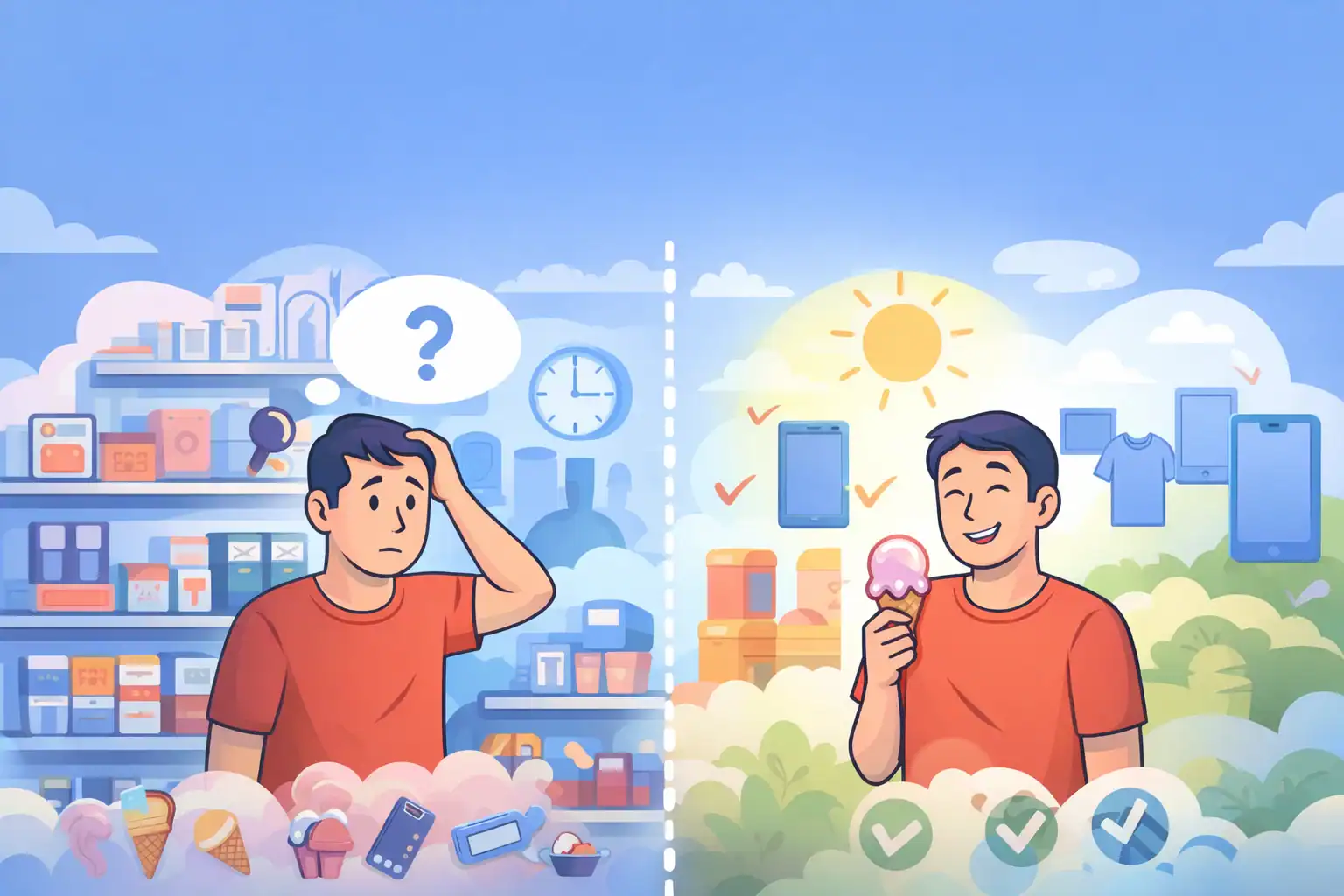
Imagine walking into a grocery store where there are five types of cereal instead of fifty. You still get to choose. You just don’t have to analyze every ingredient label like it’s an exam.
Or think about job hunting. Instead of feeling like every possible career path is open—and therefore every wrong move is permanent—you’re choosing between a smaller set of realistic, meaningful options. Suddenly, decisions feel manageable instead of existential.
The idea isn’t that choice disappears. It’s that choice stops demanding so much mental energy.
The immediate everyday impact
The first thing that changes is how much time you spend thinking about decisions after you’ve made them.
Take streaming platforms. You open Netflix, scroll for ten minutes, feel overwhelmed, and either settle on something half-heartedly or give up entirely. Now imagine a platform that offers a limited, curated set of shows for the week. You pick one. You watch it. And you don’t spend the next hour wondering if you picked the “best” thing.
That quiet relief matters.
Or look at clothing. Many people who simplify their wardrobe say the same thing: getting dressed becomes boring—in a good way. No second-guessing. No outfit anxiety. Just clothes that work. The mental space that frees up doesn’t stay empty; it gets used for better things.
Even dating apps show this effect. When there are endless profiles, it’s easy to treat people as options rather than individuals. Fewer matches often lead to deeper conversations, not because people suddenly change, but because attention stops being split in ten directions.
Less choice reduces the mental tax of constant comparison. And comparison, quietly, is exhausting.
The hidden cost we rarely notice
Here’s the part we don’t talk about much: when there are too many options, every choice carries the shadow of the choices you didn’t make.
You buy a phone. It’s good. But is it the best one for the price? Could you have waited? Should you have gone for the other model? That lingering doubt sticks around longer than the excitement of the purchase.
Multiply that by hundreds of decisions a week.
Food choices turn into guilt. Career choices turn into “what ifs.” Life paths turn into silent scoreboards we keep updating in our heads.
The strange thing is, dissatisfaction often doesn’t come from making a bad choice. It comes from imagining better ones that might exist somewhere out there.
When options are limited, that imaginary comparison space shrinks. You live more in the decision you made, not the ones you didn’t.
Sometimes happiness isn’t about getting more. It’s about wanting less after you’ve chosen.
Bigger social and long-term effects
Zoom out a bit, and the effects go beyond individual stress.
A culture obsessed with unlimited choice can quietly push people toward perfectionism. If everything is possible, then every outcome that isn’t ideal feels like a personal failure. That’s a heavy burden to carry.
Fewer choices can make commitment easier. To jobs. To relationships. To communities. Not because people are trapped, but because they’re not constantly scanning for upgrades.
There’s also something stabilizing about shared options. When people watch the same shows, use similar tools, or follow comparable paths, conversations feel easier. You don’t have to explain every decision from scratch. There’s common ground.
This doesn’t mean creativity disappears. It often thrives within boundaries. Some of the most interesting work comes from constraints, not unlimited freedom. A blank page can be more intimidating than one with a clear starting point.
Too many choices promise individuality, but they can quietly isolate us. Fewer choices sometimes bring people closer.
But let’s be honest about the limits
This idea isn’t perfect. Less choice can absolutely be harmful if it’s imposed unfairly or removes essential freedoms. Choice matters deeply when it comes to rights, safety, and personal identity.
And not everyone experiences choice overload the same way. Some people genuinely enjoy comparing options. They find it energizing, not draining. Context matters.
There’s also a risk of romanticizing simplicity. Not all limitations are liberating. Some are just limiting.
The real question isn’t whether less choice is always better. It’s when and where choice starts working against us instead of for us.
If deciding feels heavier than living with the decision, something’s off.
A thought worth sitting with
We often chase happiness by expanding possibilities. More options. More paths. More backups. But maybe happiness shows up when we stop keeping every door open and actually walk through one.
Maybe the relief we feel isn’t from choosing perfectly, but from choosing and moving on.
And maybe the next time you’re stuck between fifteen nearly identical options, the most peaceful move isn’t to analyze harder—but to choose one and let the rest go.
Sometimes freedom isn’t about having more to choose from.
It’s about having fewer things to worry about once you’ve chosen.