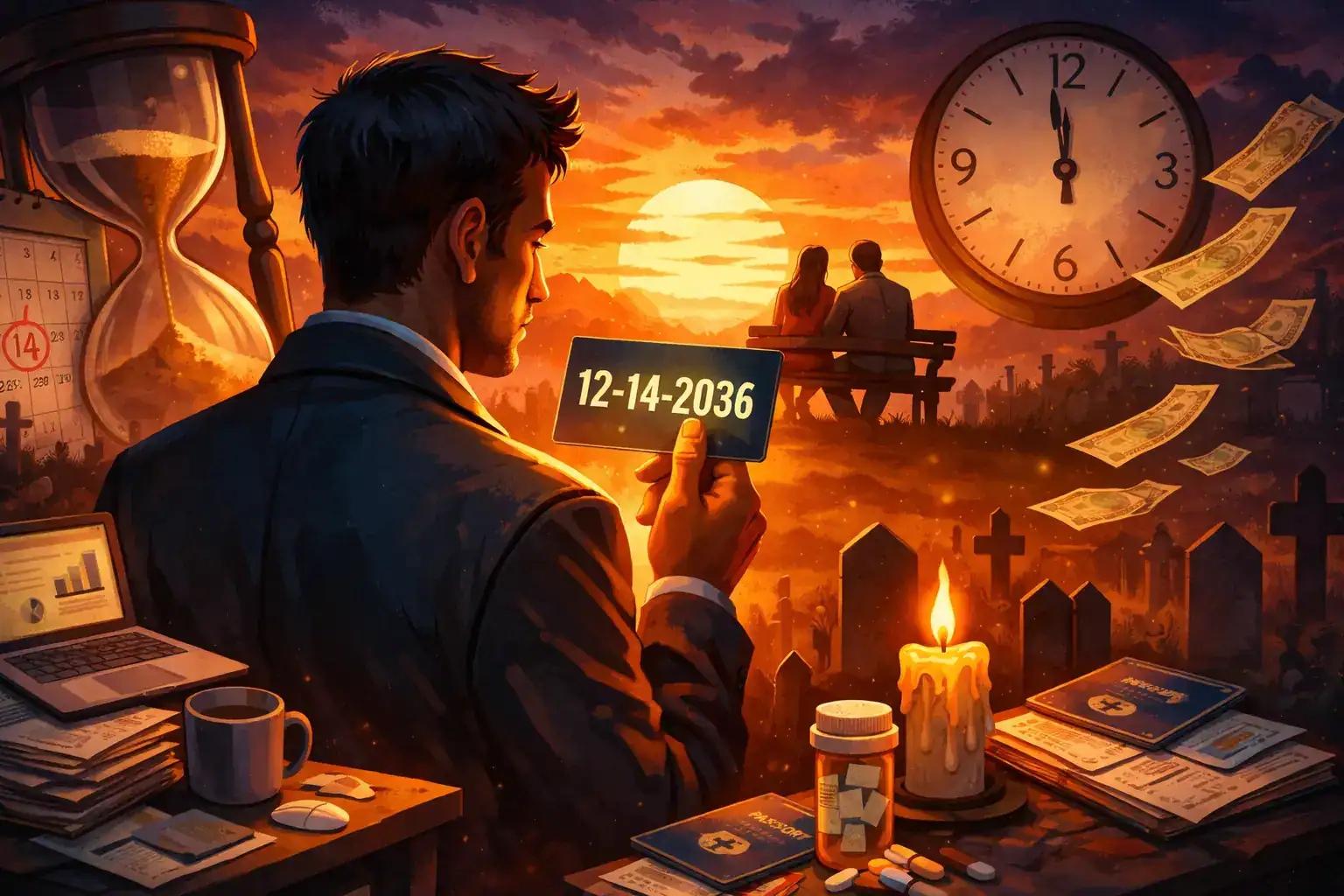
The strange thing isn’t imagining death. People do that all the time, usually late at night, usually briefly.
The strange thing is imagining a normal Tuesday where you know it’s the last one you’ll ever see.
You still set the alarm. You still check messages. You still wonder what to eat for breakfast. The world doesn’t pause just because a date on your personal calendar carries more weight than all the others combined.
That’s where this idea gets uncomfortable. Life doesn’t turn dramatic. It stays ordinary—just sharper.
What This Would Actually Mean in Real Life
Knowing your death date wouldn’t feel like a movie moment. There’s no background music. No sudden clarity. It would feel more like receiving a bank statement you didn’t ask for.
At first, you’d double-check it. Then you’d try to ignore it. After that, you’d quietly start adjusting things without telling anyone why.
Plans would change shape. Not vanish—just shift.
Someone who sees a date decades away might feel oddly relaxed. Another person, seeing a much closer year, might feel the opposite: pressure where calm used to be. Same information, wildly different reactions.
And no, people wouldn’t talk about it all the time. Most wouldn’t talk about it at all. Knowing when you die isn’t social currency. It’s personal. Heavy. The kind of thing you carry silently while pretending everything is normal.
Because from the outside, everything is normal.
The Immediate Everyday Impact (Where It Actually Starts)
The first changes wouldn’t be philosophical. They’d be practical.
You’d hesitate before signing a long contract. Five-year phone plan? Maybe not.
You’d look differently at “someday.” Someday trips. Someday projects. Someday conversations.
Some arguments would feel pointless faster. Not all—people don’t suddenly become wise—but a few would lose their grip. You’d walk away more often, not because you’re evolved, but because the cost-benefit math changes.
Even small choices would feel different. Do you really need to save that extra ₹500? Do you really want to wait until the weekend to call someone you miss?
People talk about “living in the moment,” but this would be closer to counting the moments. Quietly. Constantly.
And here’s a punchline no one expects:
Many people would still waste time. They’d just feel more aware while doing it.
How Relationships Would Quietly Change
Relationships would feel heavier, but also clearer.
Dating would become more honest and more awkward. The question “Where is this going?” wouldn’t be about emotions alone—it would be about timelines. If one person has forty years left and the other has ten, that difference doesn’t stay abstract for long.
Long-term couples would split into two groups. Some would grow closer, trimming away petty fights because there’s no appetite for nonsense anymore. Others would break faster, realizing they were postponing unhappiness under the assumption of infinite time.
Family dynamics would shift too. Parents would look at their kids and calculate birthdays they’ll never attend. Adult children would quietly count how many holidays remain with aging parents.
Knowing the end date doesn’t reduce love. It concentrates it. Sometimes painfully.
Work, Money, and the Myth of “Later”
Work culture depends heavily on pretending time is endless.
Climb now, enjoy later. Grind today, rest someday. Knowing your death date would poke holes in that logic.
Some people would stop chasing promotions. Not because they stop caring, but because the payoff window feels too small. Others would push harder than ever, determined to extract every possible outcome before the clock runs out.
Neither reaction is noble or lazy. They’re just different ways of coping.
Money would become oddly emotional. Saving feels different when you know exactly how long the savings need to last. Spending feels different when you know how many years of enjoyment are realistically left.
Retirement wouldn’t disappear—but it would lose its shine for many. Why wait until 65 to live differently if you’re not guaranteed to see 66?
This is where a subtle truth shows up:
Knowing the end date wouldn’t make people reckless. It would make them selective.
Health Choices Get Uncomfortably Honest
Health advice is built around extending life. Knowing your death date would shift the focus to quality instead.
Some people would still eat better, exercise, sleep well—not to add years, but to feel decent during the years they have. Others would relax their discipline, deciding that denial tastes better than discipline.
Doctors would face harder conversations. Preventive care wouldn’t be one-size-fits-all anymore. Treatment decisions would include emotional math, not just medical charts.
And mental health would quietly move to the center of everything. Knowing the countdown can calm some people. For others, it would feel like a ticking sound no one else can hear.
Ever tried enjoying a vacation while watching the clock?
Now imagine that clock never turns off.
Bigger Social Effects Over Time
Once the initial shock fades, society would adjust. It always does.
Education paths would change. Spending ten years preparing for a future you won’t reach wouldn’t make sense for everyone. Career paths would become shorter, sharper, more flexible.
Crime patterns might shift in strange ways. Some people would avoid trouble, not wanting to waste limited time. Others might stop caring about consequences entirely.
Religion, philosophy, and spirituality wouldn’t disappear. If anything, they’d get louder. When the “when” is fixed, the “why” becomes harder to ignore.
Governments would face uncomfortable questions they’re already bad at answering. Healthcare priorities. Prison sentences. Social support. When everyone’s timeline is visible, fairness becomes harder to define.
Real-World Clues We Already Have
We don’t need imagination to see how people behave with a deadline.
People with terminal diagnoses often report sharper priorities. Not constant bravery—just fewer delays. They still get bored. Still get angry. But they stop waiting for permission to live differently.
Athletes forced into early retirement show a similar pattern. When the future collapses, identity has to rebuild fast—or crack.
Even everyday deadlines work this way. A task due “someday” drifts. A task due tomorrow reshapes your evening completely.
A death date would be the ultimate deadline. And deadlines don’t turn us into saints. They turn us into ourselves, faster.
The Limits of Knowing
There’s a comforting idea that knowing the end would fix us. Make us kinder. More present. More grateful.
It wouldn’t.
Some people would rise to it. Others would spiral. Most would land somewhere in between—still flawed, still distracted, just more aware of what distraction costs.
The date wouldn’t give life meaning. It would remove the illusion that meaning can wait.
And that’s the part many people wouldn’t like.
A Thought That Sticks
Right now, you don’t know your death date.
But look at how you behave.
You delay things that matter. You rush things that don’t. You act as if time is endless right up until it suddenly isn’t.
Maybe knowing the exact date wouldn’t change everything.
Maybe it would just make one question harder to ignore:
If your time were clearly limited, what would you stop postponing tomorrow?
And what would feel too important to wait any longer—starting today?