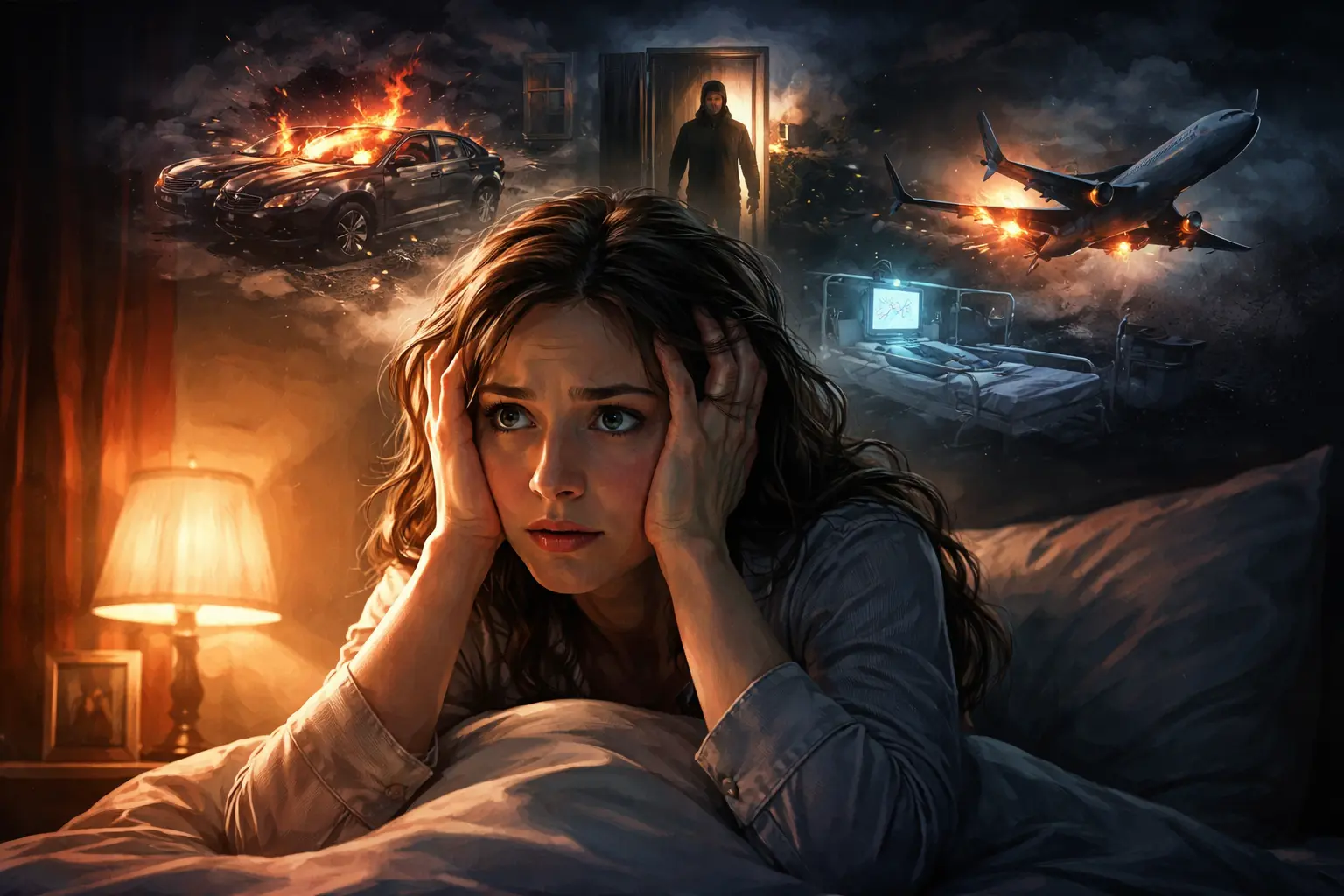
You send a text to someone important and they don't reply for a few hours. Almost immediately, your brain starts filling in the silence. Maybe they're upset with you. Maybe you said something wrong. Maybe something terrible has happened to them. You know, rationally, that they're probably just busy. But the knowing doesn't stop the imagining. The worst-case scenario plays out anyway, vivid and uninvited.
Or you're waiting on medical test results. The doctor said it was probably nothing. You heard the words. You even believed them for a moment. But by the next morning, you're deep in a spiral you didn't choose to enter. The mind goes there before you can stop it.
This is one of the strangest and most universal features of being human. We imagine disasters that haven't happened. We rehearse conversations that will likely never occur. We feel the emotional weight of outcomes that exist only in our heads. And we do it constantly, automatically, and often without realizing we've started.
Understanding worst-case thinking isn't just an interesting psychological curiosity. It's a window into why the brain is built the way it is — and why the very thing that makes us anxious might also be what has kept our species alive.
The Brain Was Built for Danger, Not Comfort
The starting point for understanding this has nothing to do with modern life. It starts much further back, in environments where the stakes of getting something wrong were immediate and often fatal.
Our ancestors didn't live in a world where a missed text message caused mild social awkwardness. They lived in a world where a rustling in the grass could mean a predator. Where eating the wrong plant could kill you. Where a misjudged relationship within the group could leave you isolated — and isolation, back then, was not just unpleasant. It was dangerous.
In that context, the brain developed a very sensible strategy: assume the worst, and you'll survive to be wrong. Assume the best, and you might not get a second chance. This bias toward negative outcomes wasn't a flaw in early human cognition. It was a feature. The individuals who heard a sound and immediately imagined a threat were more likely to survive than those who heard the same sound and thought nothing of it.
Neuroscientists call this the negativity bias. The brain doesn't treat positive and negative information equally. It weights threats more heavily, stores them more vividly, and recalls them more easily. This is why a single criticism can overshadow ten compliments. Why one scary news story can shape how we think about the world for weeks. Why we replay embarrassing moments from years ago but can barely remember what made us happy last Tuesday.
The brain isn't broken when it jumps to worst-case scenarios. It's doing exactly what it evolved to do. The problem is that it hasn't caught up with the world we actually live in.
The Amygdala and the Alarm That Never Quite Turns Off
There's a specific structure in the brain that sits at the center of all this: the amygdala. It's a small, almond-shaped region deep in the brain's limbic system, and its primary job is threat detection. It scans incoming information — constantly, automatically, without any conscious instruction from you — and asks one question above all others: is this dangerous?
When it decides the answer is yes, it triggers the stress response. Heart rate increases. Attention narrows. The body begins preparing for fight or flight. All of this happens before the rational, thinking part of your brain — the prefrontal cortex — has even had a chance to weigh in.
This is why understanding worst-case thinking requires understanding timing. The emotional reaction comes first. The reasoning comes second. By the time you're telling yourself everything is probably fine, your body is already halfway into a stress response. You're not being irrational. You're being human in exactly the sequence the brain is designed to operate.
The amygdala also doesn't distinguish particularly well between real threats and imagined ones. If you vividly picture something frightening, the brain responds to that image with genuine physiological arousal. This is why horror movies make us jump even though we know we're watching a screen. It's why rehearsing an awkward conversation makes your palms sweat. The brain reacts to the thought of danger in ways that are neurologically similar to reacting to danger itself.
So when you find yourself spiraling through worst-case scenarios, you're not just thinking scary thoughts. Your nervous system is treating those thoughts as real events. The body keeps score, as some researchers have put it. And it keeps score even when the game hasn't started yet.
Why Imagination Makes It Worse
Here's what makes the psychology behind imagining worst outcomes particularly interesting: humans are exceptionally good at imagining the future. Far better than most other species. This capacity for what psychologists call prospective thinking — the ability to simulate future events in the mind — is one of our greatest cognitive gifts. It allows for planning, creativity, problem-solving, and the kind of long-term thinking that has built civilizations.
But the same capacity that lets you plan a vacation, write a novel, or design a building also lets you conjure catastrophe with remarkable detail. You can picture the argument that hasn't happened yet. You can feel the humiliation of the failure that hasn't occurred. You can walk through the grief of a loss that is, so far, entirely theoretical.
The brain doesn't label these simulations as fictional. It runs them as though they're happening. And because the amygdala responds to imagined threats in ways that overlap with how it responds to real ones, a vivid worst-case scenario isn't just an unpleasant thought. It's an experience.
This is part of why we fear worst-case scenarios with such intensity — they're not entirely hypothetical to the nervous system. The body has already lived through them, in a sense. Partially, incompletely, but enough to produce genuine emotional residue.
There's also the matter of uncertainty. Research in psychology has consistently shown that uncertainty is often more distressing than known bad outcomes. People who know something bad is going to happen tend to cope better than people who are waiting to find out. The unknown space is where worst-case thinking thrives. The mind hates a vacuum, and it fills the space of not-knowing with the thing it's evolved to prioritize: the most threatening possibility.
When Catastrophizing Becomes a Habit
For some people, worst-case thinking doesn't stay in the background. It becomes the dominant mode of engaging with the world. Every unanswered email is a sign of professional failure. Every minor physical symptom is a serious illness. Every slight social awkwardness is evidence that people dislike them. Psychologists call this catastrophizing — the tendency to automatically assume the most negative possible interpretation of events.
Catastrophizing isn't a character flaw. It's a pattern, often learned. Sometimes it develops from early environments where threats were genuinely frequent and unpredictable, so the brain learned to stay on high alert all the time. Sometimes it's reinforced gradually, as a person comes to experience hypervigilance as a form of control — if I imagine everything that could go wrong, I won't be caught off guard.
This is the hidden logic of why we fear worst-case scenarios so persistently: imagining them can feel like preparation. If you've already mentally rehearsed the disaster, maybe the disaster will hurt less when it arrives. Maybe you'll be ready. This belief is rarely examined consciously, but it operates powerfully beneath the surface.
The cruel irony is that this strategy tends to produce the suffering it's trying to prevent. The person who catastrophizes doesn't avoid pain — they experience pain repeatedly, in advance, for events that often never happen. Studies suggest that a significant portion of what people worry about either never occurs or turns out to be far less catastrophic than anticipated. The brain imagined the worst. Reality delivered something considerably more manageable.
The Thin Line Between Worry and Wisdom
None of this means that worst-case thinking is purely destructive. This is the part of the psychology that tends to get lost when people frame anxiety as simply a problem to solve.
There is a version of negative thinking that is genuinely useful. Thinking through what could go wrong before a major decision is a sophisticated cognitive act. It's how engineers design safe systems. It's how doctors think through differential diagnoses. It's how thoughtful people navigate complex relationships and commitments. There's even a formal practice built around this idea — called premortem analysis — where teams imagine that a project has already failed and then work backward to understand why. This kind of structured worst-case thinking produces better decisions.
The difference between useful negative thinking and destructive catastrophizing isn't really about content. It's about function. Useful worry leads somewhere. It generates information, prompts action, and then releases. Catastrophizing loops. It doesn't resolve. It just cycles through the same dark possibilities without arriving at anything actionable.
When worst-case thinking is doing its job, it's pointing at something real that deserves attention. When it's stopped doing its job, it's replaying old threat-detection patterns that no longer apply to the situation at hand. The amygdala firing at a rustling in the grass made sense when the grass contained predators. The amygdala firing at an unread email in the twenty-first century is the same hardware running in a very different world.
What Actually Helps — And Why
Understanding the psychology behind imagining worst outcomes changes how you relate to those imaginings. Not because understanding them makes them disappear, but because it removes the second layer of suffering — the anxiety about the anxiety, the worry about the worrying.
When you recognize that the brain jumping to catastrophe is an ancient protective mechanism doing its best in a context it wasn't designed for, the experience shifts. It's not evidence that something is wrong with you. It's evidence that you have a brain. A very old brain, doing a very old job.
Therapists working in cognitive behavioral frameworks often help people examine the actual probability of the worst case occurring, and then — crucially — their capacity to handle it if it did. This second step matters more than most people realize. A significant portion of catastrophic fear isn't really fear of the outcome itself. It's fear of not being able to cope with the outcome. When people genuinely reckon with the evidence of their own resilience — what they've survived before, how they've adapted, what resources they have — the worst case tends to lose some of its power.
Mindfulness practices work on a different mechanism. Rather than arguing with the content of worst-case thoughts, they change the relationship to those thoughts. The thought arises. You notice it arising. You observe it without immediately fusing with it, without treating it as a report from reality. This doesn't stop the thoughts — nothing really does — but it changes how much authority they carry.
Neither approach is about forced optimism. The goal isn't to replace catastrophic thinking with cheerful predictions. It's to allow the thinking to do its job — to flag the possibility, to prompt attention — without letting it take over the whole room.
The Thought That's Worth Sitting With
Here is what's genuinely strange about all of this. The same capacity that generates our worst fears is also the thing that makes us capable of empathy, planning, storytelling, and care. Imagining what could go wrong for someone you love is the dark side of the same coin as imagining what they're feeling, what they might need, what their experience is like from the inside.
The brain that catastrophizes is the brain that cares. The mind that rehearses disasters is the mind that is paying attention to what matters. The anxiety, at its root, is pointing at something it considers worth protecting.
The interesting question isn't really why do we fear worst-case scenarios. The brain's answer to that is fairly clear: because it has always feared them, because that fear has served us, because the cost of being wrong in the direction of safety was historically far lower than the cost of being wrong in the direction of optimism.
The more interesting question is what we do with the awareness. Once you know the mechanism — once you can see the ancient alarm system firing at modern noise — you have a choice that your ancestors didn't quite have. Not to silence the alarm. But to hear it differently. To ask what it's actually pointing at, and whether that thing deserves the full weight of your attention or just a portion of it.
The worst case is rarely what happens. But the mind that imagined it is the same mind that kept you careful, kept you connected, kept you asking whether the people you love are okay. There's something worth understanding in that. And once you do, the spiral doesn't vanish — but it becomes something you recognize rather than something that simply happens to you.