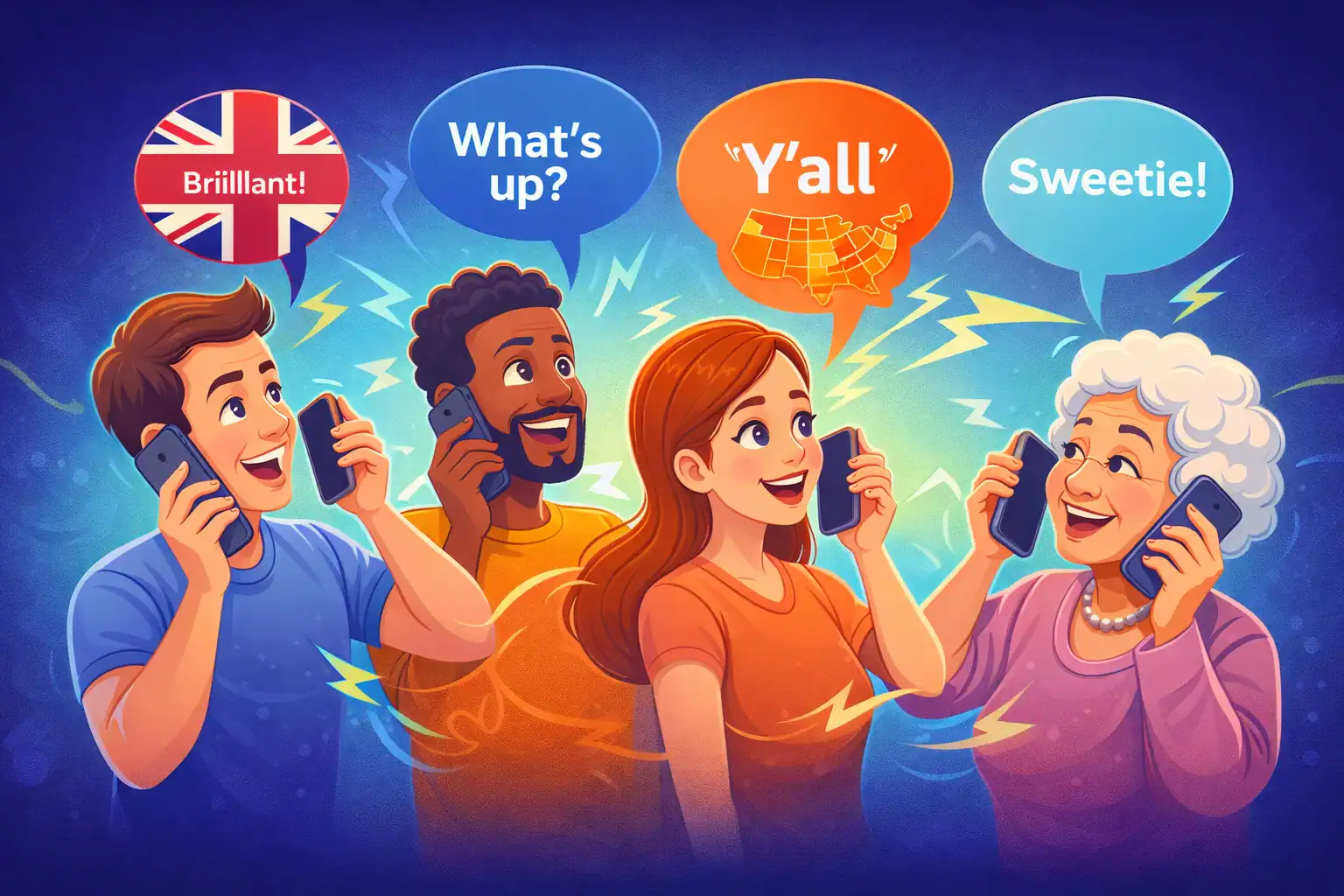
You’ve probably caught yourself doing it at least once. You spend a weekend visiting a friend from the American South, and by Sunday evening you’re stretching your vowels a little. You binge a British show for two weeks and suddenly you’re saying “brilliant” with a slightly different mouth shape. You get off a call with your grandmother and realize you spent the last ten minutes sounding exactly like her.
Nobody told you to do it. You weren’t trying. It just happened.
Here’s the thing nobody tells you: your voice has been quietly shaped by every person you’ve ever been close to — and it’s still happening right now, in every conversation you have.
This isn’t a quirk. It isn’t mockery. It’s one of the most quietly fascinating things the human brain does automatically — and most people go their entire lives without realizing it has a name, a mechanism, and a reason rooted deep in evolutionary history.
In This Article
Why Do I Copy Accents Without Realizing It?
The formal term is linguistic accommodation or phonetic convergence. Strip away the academic language and here’s what it actually means: your voice is socially contagious. When you’re around someone long enough — or even just intensely enough — your speech starts bending toward theirs. Subtly. Below conscious thought.
This sits inside a broader phenomenon psychologists call the Chameleon Effect.
What Is the Chameleon Effect in Communication?
In 1999, psychologists Tanya Chartrand and John Bargh demonstrated that people unconsciously mimic the postures, gestures, and mannerisms of whoever they’re interacting with. We mirror body language, facial expressions, even breathing patterns. Speech is no different — it might actually be the most sensitive channel of all.
The Chameleon Effect isn’t performance. It’s not people-pleasing. It’s your nervous system doing what it was built to do: find common ground with other humans, fast.
And here’s the part worth sitting with — the more you like someone, the stronger the effect. Accent mirroring, in this sense, is a compliment your body pays before your brain has made up its mind.
Do Mirror Neurons Cause Accent Copying?
This is where neuroscience gets genuinely interesting. Mirror neurons are cells in the brain that fire both when you perform an action and when you observe someone else performing it. They’re why you wince when someone stubs their toe. They’re why yawning is contagious.
When you hear someone speak, a region called Broca’s area — heavily involved in language production — partially activates as if you were speaking yourself. You’re rehearsing their sounds without intending to. The result is that your vocal system gets nudged, ever so slightly, in their direction.
Is accent copying automatic? Almost entirely yes. The finer adjustments — millisecond differences in consonant timing, micro-shifts in vowel quality — happen below the reach of conscious control. You can suppress the most obvious imitation once you’re aware of it, but the subtle machinery keeps running regardless.
Is Accent Mirroring a Sign of Empathy?
Yes, and this is one of the more striking findings in this space. People who score high on empathy measures show stronger phonetic convergence. Actors — who spend careers inhabiting other people’s emotional realities — are particularly susceptible to picking up accents quickly. It’s not a coincidence.
If you find yourself mirroring accents easily, it likely means you’re someone who tunes into people at a deep level. There are worse things to be.
Why Does My Accent Change Around Certain People?
Because your brain is running a social calculation you never consciously agreed to.
Phonetic convergence is strongest with people you feel positively toward — people you find warm, credible, or attractive. The closer the relationship, the stronger the pull. This is why your voice around your best friend sounds different from your voice in a job interview, which sounds different again from how you speak to your grandparents.
You’re not being inconsistent. You’re being human. Your accent is, in some sense, a real-time read-out of your relationship to whoever is in the room.
The uncomfortable version of this truth: your voice is making social decisions before you are.
Is It Rude, or Just Natural?
This is the question that makes people genuinely uncomfortable. If you’re from one background and you start speaking like someone from a completely different one, is that mockery? Appropriation? Just weird?
The distinction that matters is intent versus automaticity. Deliberate accent imitation — performed, exaggerated, done for effect — reads very differently from unconscious convergence. People can usually feel the difference even when they can’t explain why.
Do people notice when you copy their accent? Rarely, unless it’s obvious. The shifts that happen through genuine accommodation are too subtle — a slight softening here, a rhythm adjustment there. What people do notice is how the conversation feels. And conversations with strong accent mirroring tend to feel warmer and more connected.
The discomfort arises when it looks intentional, or when the power dynamic is off. Context is everything.
Accent Bias, AAVE, and the “Neutral Accent” Myth
This is the part of the conversation that doesn’t get nearly enough attention.
Accent copying isn’t happening in a vacuum. It takes place inside social systems where some accents are treated as professional and others as problems to be fixed. The pressure to converge toward a so-called “neutral” accent — which, in most English-speaking workplaces, really means a white, middle-class, regionally unmarked voice — is not equally distributed.
Speakers of African American Vernacular English (AAVE) have long navigated this in ways that white speakers simply haven’t had to. Code-switching for Black Americans often isn’t about comfort or connection — it’s about being taken seriously, being hired, being safe. The same accent accommodation that feels like a charming quirk for one person can feel like an erasure of identity for another.
Research consistently shows that people with strong regional or non-Western accents face discrimination in hiring, housing, and even healthcare. Landlords respond differently to voicemails. Doctors make different assumptions. Juries evaluate credibility differently. Accent bias is real, it’s measurable, and it operates largely unconsciously — which makes it harder to challenge.
The irony is sharp: the same brain mechanism that makes us converge toward people we like also makes us judge people who sound “different” as less competent or trustworthy. Accent mirroring is social bonding. Accent bias is social exclusion. Both are running on the same subconscious hardware.
Why does my accent disappear at work? For many people — especially those who grew up speaking a regional dialect, a working-class variety, or a non-dominant form of English — the workplace accent is survival code-switching. It’s not losing yourself. It’s navigating a world that wasn’t designed with your voice in mind.
Code-Switching vs Accent Copying — They’re Not the Same
These two get conflated constantly, and they shouldn’t.
Code-switching is deliberate and often strategic — shifting between languages, dialects, or registers depending on context. A bilingual person might speak English at work and switch to Spanish at home. A first-generation immigrant might maintain one accent with family and develop another for professional settings. For many people, this is less a choice and more a requirement.
Accent copying is unconscious phonetic convergence — the automatic drift toward someone else’s speech patterns mid-conversation.
The overlap is real: both involve your accent shifting depending on who you’re with. But one is chosen; the other happens to you.
Why do bilingual people change accents? Because they’re operating in multiple linguistic worlds simultaneously, and the brain adapts to each context independently. Both accents are genuine. Neither is fake.
Why do immigrants develop two accents? The home accent stays warm and intact; the external accent develops as a practical tool. This dual-accent existence is remarkably common and remarkably underappreciated.
Why Couples and Close Friends Start Talking Alike
Couples who’ve been together for years develop subtle vocal similarities — not the same accent exactly, but shared rhythms, similar pacing, matching ways of landing emphasis. Neither person planned it. Neither noticed it happening. And yet someone who knew them a decade ago would hear it immediately.
Why do best friends talk the same? Extended exposure, emotional closeness, repeated interaction — these are exactly the conditions that produce the strongest phonetic convergence. You are, in a measurable sense, shaped by the voices you spend the most time around.
Do children copy their parents’ accents? Overwhelmingly yes — and this is how accents are transmitted across generations. Children don’t learn their accent from instruction. They absorb it from caregivers during the years when language acquisition is most plastic. A child’s accent is essentially a map of who raised them.
There’s something quietly moving about that, if you think about it too long.
The Brain Science Behind Accent Shifts
Your brain’s ability to shift speech patterns relies on neuroplasticity — the nervous system’s capacity to rewire itself based on experience. Broca’s area and the motor cortex regions governing mouth and tongue movement remain malleable well into adulthood.
This is why accent training works. It’s also why long-term exposure to a new linguistic environment — living abroad, working in a different region — can produce real, lasting changes. The brain responds to repetition. Feed it the same sounds consistently, and it starts reorganizing around them.
Can the brain rewire accents permanently? Yes, though it varies by age and length of exposure. People who move countries in their twenties frequently find that after a decade, their original accent has softened or hybridized in ways that feel involuntary. Neuroplasticity doesn’t stop just because you’d prefer your old voice back.
Is Accent Copying a Survival Instinct?
For most of evolutionary history, sounding like the people around you wasn’t a social nicety — it was a signal of belonging. Accents and dialects function as acoustic badges of identity. They say: I’m from here. I’m with you. We share the same ground.
The unconscious drive to converge toward the speech of those around you may be, at root, a very old bonding mechanism. The fact that accent mirroring is stronger with people we like, and weaker or reversed with people we distrust, suggests this isn’t random — it’s a social signal system running beneath every conversation.
The modern version is gentler. But the ancient logic is still running.
Can You Control It? When Accent Copying Becomes Intentional
Knowing this happens doesn’t stop it. The automatic machinery keeps running regardless. But awareness does let you notice it — and occasionally, steer it.
Do politicians change accents intentionally? Yes, and it’s well-documented. Politicians modulate their speech depending on audience — going broader in working-class settings, flattening out for national broadcasts. The calculated version and the genuine accommodation often look identical from the outside, which is part of what makes it effective.
Why do actors change accents so easily? Because their training sharpens exactly the processes that already exist in everyone. An actor doing dialect work is doing an intentional, high-precision version of what the rest of us do automatically. Same mechanism, more control.
Is accent training possible for regular people? Yes. Speech therapists and dialect coaches work on exactly this — deliberately accelerating the neuroplastic process that would happen anyway with sufficient exposure.
Have You Noticed This About Yourself?
Here are five situations where accent mirroring is most likely happening without your awareness:
After binge-watching a show — Two weeks of a British drama and your vowels shift. It happens to almost everyone, and it says nothing embarrassing about you.
After traveling — Even a short trip to a different region can leave a faint residue in how you speak for weeks afterward.
After joining a new friend group — Give it six months. Listen to an old voicemail from before. You’ll hear the difference.
After starting a new job — Your pacing changes, your register shifts, certain words disappear. The workplace accent is one of the most underacknowledged social phenomena in professional life.
When talking to elders vs. friends — Most people slow down, enunciate more clearly, and shift register with older relatives without thinking. That’s accommodation too.
FAQs
Why do I copy accents without realizing it?
It’s an automatic neural process driven by mirror neurons and the brain’s social mimicry system. It signals rapport and belonging, and operates below conscious awareness.
Why does my accent change around certain people?
Phonetic convergence is strongest with people you feel positively toward. The more engaged you are in a conversation — emotionally or intellectually — the stronger the pull toward the other person’s speech patterns.
Is accent mirroring a sign of intelligence?
Interestingly, yes — in a specific sense. Higher cognitive flexibility and stronger social perception both correlate with stronger accent accommodation. People who pick up accents quickly tend to be good at reading social contexts and adapting to them. It’s a form of interpersonal intelligence, not a lack of identity.
Why do I pick up accents so quickly?
Some people are simply more neurologically susceptible to phonetic convergence. Higher empathy, greater openness to experience, and strong auditory processing all contribute. If you pick up accents fast, you’re probably also someone who reads rooms well.
Why do I sound British after watching British shows?
Extended exposure to any accent activates the same neural rehearsal processes that operate in live conversation. Your brain doesn’t fully distinguish between a screen and a person — repeated input is repeated input, and the motor system responds accordingly.
Why do I talk differently around my partner?
Shared vocal patterns are one of the most consistent markers of close relationship bonds. You’re converging because you’re genuinely connected. It’s one of the less-discussed ways long-term relationships leave a mark on you.
Is accent mirroring a sign of attraction?
Research suggests convergence is stronger between people who feel mutual positive regard, which includes attraction. If you find yourself unconsciously matching someone’s speech especially quickly, your brain may have already decided something your conscious mind hasn’t caught up with yet.
Is copying accents offensive?
Unconscious accommodation, no. Deliberate, exaggerated imitation — especially across cultural or racial lines — is a different matter entirely. The intent and execution make all the difference.
Why does my accent disappear on phone calls?
Audio-only communication places higher demands on vocal clarity, which often activates more deliberate speech. Many people also unconsciously shift toward a more “standard” register when the visual context disappears and they feel more exposed.
The Part That Stays With You
Your accent is not purely your own. It’s a record of your relationships, your geography, your history — every person you loved, every place you lived, every room you spent enough time in to let the sounds sink in.
Language is the thing we use to express who we are. And yet, almost without trying, we use it to dissolve into each other a little. Every conversation involves a quiet, invisible negotiation that nobody agreed to and almost nobody notices.
There’s a version of you that exists only around certain people. Not fake — just tuned differently. And every version is real.
Your voice has always been a conversation, even when you thought you were just talking.