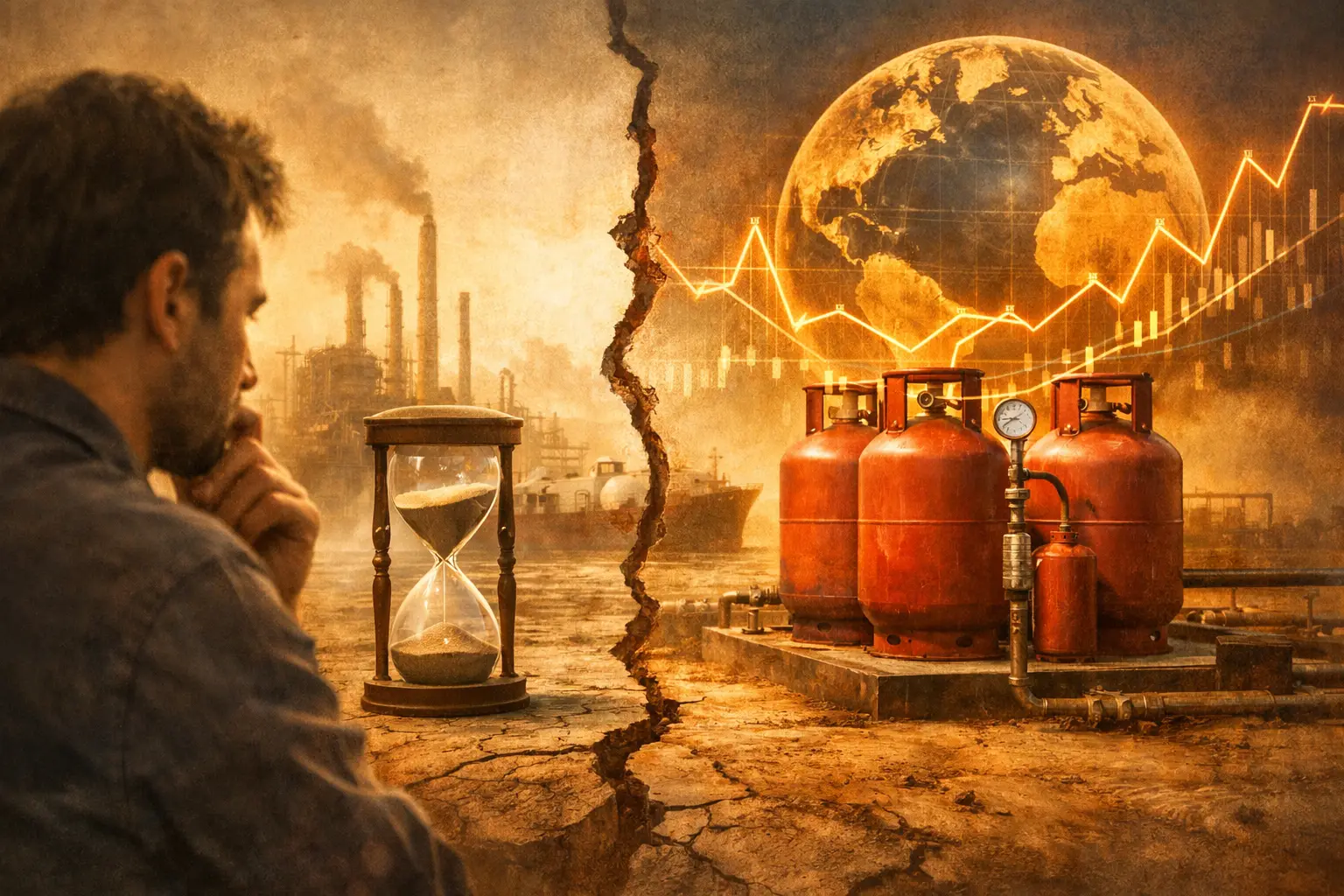
You stood in your kitchen three mornings ago — maybe it was last week — and you turned on the gas burner and everything was fine. Normal. Unremarkable. Then someone in your building WhatsApp group sent a message: "Anyone else's cylinder running low? My new booking has been pending for five days." And just like that, something you'd never thought about became a quiet, low-grade emergency.
That's how an LPG crisis announces itself. Not with headlines. With a neighbor's message.
Table of Contents
Why the LPG Crisis Is Getting Worse Right Now
Before we get to the longer story, there's something immediate worth understanding — because the gas cylinder shortage you're experiencing didn't appear out of nowhere.
On March 13, 2026, protesters were detained in New Delhi during demonstrations against LPG price hikes and supply disruptions Council on Foreign Relations — and the reason traces back to a body of water most Indians have never had reason to think about: the Strait of Hormuz.
The US-Israeli military operation against Iran — codenamed "Operation Epic Fury" — led Iran to close the Strait of Hormuz, disrupting roughly 20 percent of global oil supplies. Wikipedia This is the single chokepoint through which the overwhelming majority of India's LPG imports flow. Exports via the Strait of Hormuz accounted for 90 percent of India's 23.4 million tonnes of LPG imports in 2025. Argus Media When that corridor effectively closed, there was no clean alternative.
Strikes on the massive Ras Tanura refinery in Saudi Arabia, the Ras Laffan gas processing base in Qatar, and the Ruwais refinery complex in the UAE have resulted in a drop of Gulf oil production by 10 million barrels per day compared to March 2025. Council on Foreign Relations The propane price index surged by 53 percent between late February and mid-March, hitting 12-year highs. Argus Media The LPG you cook with every morning is priced in those global markets. And right now, those markets are in a state they haven't seen in decades.
The International Energy Agency described the situation as "the greatest global energy security challenge in history." Al Jazeera That's not rhetoric. That's why your booking is pending.
The Quiet Chain That Feeds Your Kitchen
India doesn't produce enough LPG to meet its own demand. It never has. The country imports roughly 40 to 50 percent of its LPG needs — primarily from Saudi Arabia and the UAE — and that pipeline now runs through a war zone. Offers for April LPG imports were reported at $1,000 per tonne — a premium of $300 to $400 per tonne above normal swap prices. Argus Media India's government directed domestic refiners to raise LPG output by about 25 percent, directing the entire domestic production toward household consumers. But domestic production was never designed to carry the full load.
The LPG shortage is therefore being driven by a cluster of pressures converging at once. Shipping costs have surged. Insurance premiums on Gulf routes have hit levels that are making carriers hesitate to send vessels through the Strait at all. And India's own distribution infrastructure — the network of bottling plants, transporters, and last-mile distributors — was already under strain before the war began.
The Pradhan Mantri Ujjwala Yojana scheme brought LPG connections to over 100 million households that previously cooked on firewood or dung cakes. That's a genuine social achievement. It also means that the demand base is now vast, the buffer is thin, and the seams show quickly when the supply chain is hit.
When the World Goes to War, Your Cylinder Waits
Here's what most news coverage still underemphasizes: LPG is a byproduct of both crude oil refining and natural gas processing. Its availability is tangled up with the same geopolitics that set oil prices — and right now that geopolitics has never been more volatile.
Qatar — a major LNG producer exporting around 10 billion cubic feet per day — shut down its production following drone attacks, cutting 20 percent of world LNG trade. Resources Magazine Iran's attacks on Qatar's South Pars gas facilities and retaliatory strikes on Ras Laffan have caused oil prices to briefly touch $120 a barrel. Foreign Policy Research Institute Maritime traffic in and out of the Strait of Hormuz has slowed to a trickle, with insurance costs making tankers hesitate to transit even when they technically could. The Washington Institute
The government faces a familiar impossible calculation: absorb the price surge through subsidies — which cannot go on indefinitely — or let some of it pass to consumers. Analysts have warned that gas supplies are the most immediate concern, and that the situation could worsen within a week if government subsidies lapse. Council on Foreign Relations These decisions happen in rooms you'll never see. But the outcome shows up as a booking that stays pending.
Why People Panic During a Gas Shortage
Now here's the part that turns a genuine shortage into a compounded crisis.
The moment people hear that cylinders might be delayed, something shifts in how they think about their own supply. Even people with a half-full cylinder — weeks of cooking left — start to feel anxious. They book a refill early. Their neighbor, seeing the booking, does the same. The distributor, already stretched, now faces a demand spike that didn't exist the week before. The gas cylinder shortage that was real but manageable becomes, through the mechanism of collective anxiety, significantly worse.
This is called demand-pull panic, and it's as old as scarcity itself. Psychologists who study resource behavior talk about the scarcity mindset — the way our cognitive bandwidth narrows when we sense a resource running low, even if it hasn't yet. The brain stops asking "how much do I actually need?" and starts asking "what if I can't get it at all?" Those are very different questions, and they lead to very different behavior.
There's also social proof at work. If your neighbor is stocking up, that's a signal. Not a rational argument — a signal. And we're wired to read those signals as information, even when they're just fear echoing back at itself.
The Everyday Cost Nobody Tallies
The LPG shortage doesn't just affect home kitchens, though that's the most personal version of it. Small dhabas and street food vendors run on cylinders bought at commercial rates, which are higher than subsidized domestic ones. When supply tightens, commercial customers — who have less pricing protection — feel the squeeze first and hardest. A dhaba that can't get a cylinder might raise prices, reduce portions, or simply close early. You never see the connection, but it's there.
For middle-class urban households, the inconvenience is real but manageable. For families on the economic edge — those who depend on Ujjwala connections, who have no backup option, no microwave, no induction cooktop — a delayed cylinder isn't a nuisance. It's a genuine disruption to daily nutrition.
What Comes Next
Unlike sanctions-driven disruptions, a sustained blocking of the Strait of Hormuz obstructs not only trade routes, but the very ability of producers to export — pushing markets beyond adjustment mechanisms into forced demand destruction. Al Jazeera This is not a problem that resolves in a week. Even if the Strait reopened tomorrow, damaged infrastructure like Ras Laffan and South Pars facilities might not be fully operational for several years. Argus Media
India is working to source LPG from alternative suppliers — the United States, among others — but US export terminals are already bottlenecked, and spot premiums for alternative supply have soared. Argus Media The easing, when it comes, will be gradual.
Book your refill when you genuinely need it — not weeks ahead out of anxiety. That early booking, multiplied across millions of households, is part of what's making the line longer for everyone. Keep one spare if your household genuinely goes through cylinders quickly. But avoid stocking more than you'd ordinarily hold — not because the rules say so, but because you're part of a shared system, and the way you behave in it actually affects your neighbors.
The Thing Worth Sitting With
Sometimes a crisis isn't caused by the shortage itself — it's caused by the fear of the shortage, and that fear makes the shortage real.
There is something quietly revealing about how a country responds when the fuel that runs its kitchens becomes a casualty of a war it didn't start, in a strait it can't control, over a conflict it's watching from a distance. India's scale of demand limits how long it can cap prices to shield consumers Council on Foreign Relations — and that tension, between a government trying to hold the line and a supply chain that has broken down at the source, is what shows up as a WhatsApp message from your neighbor.
The thread connecting a closed strait to the flame under your morning chai was always there. You just never had to think about it before.