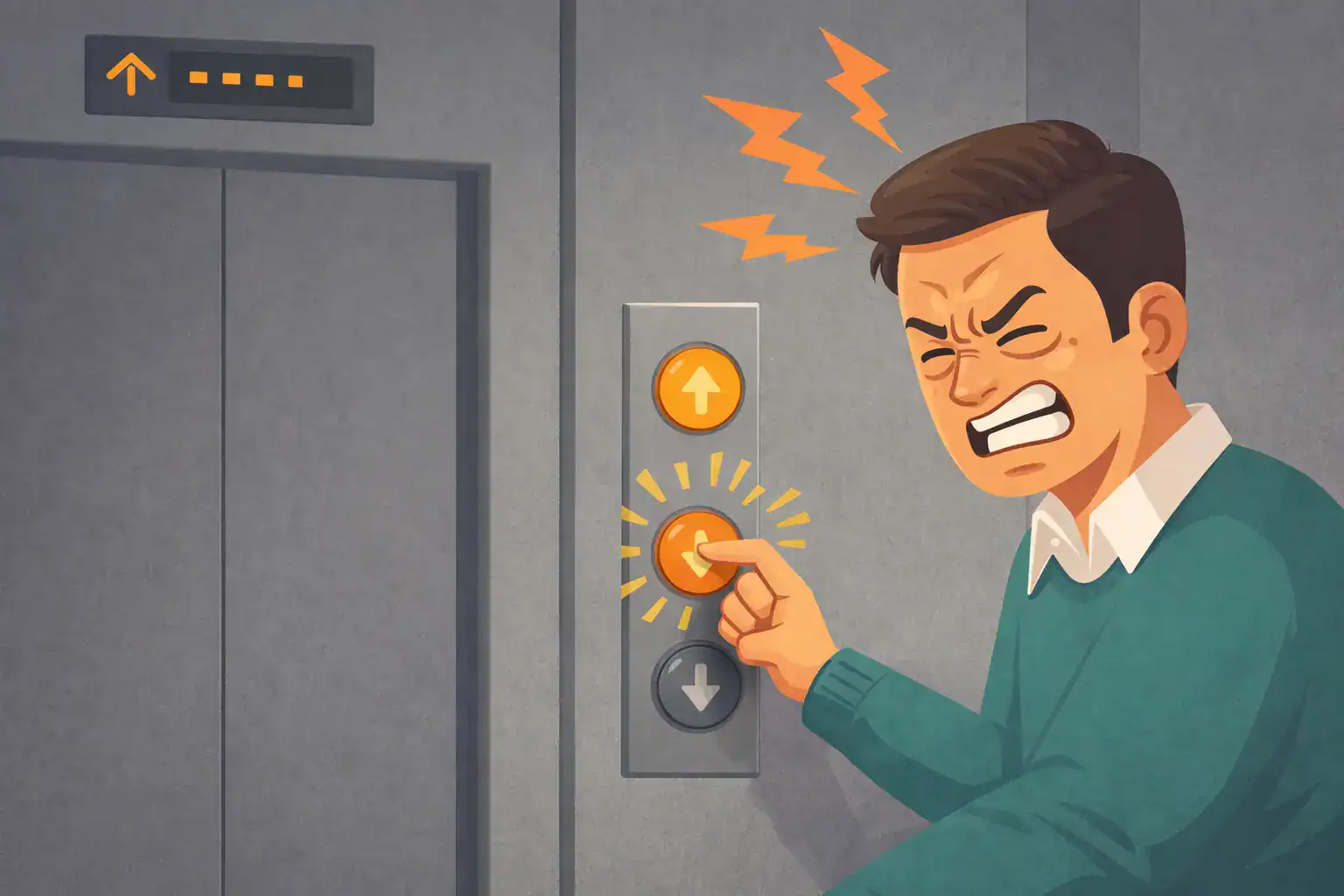
You’ve seen it. You’ve probably done it. You press the elevator button once. Nothing happens. So you press it again. And again. Maybe a little harder this time, as if pressure equals persuasion. Somewhere in the back of your mind, you know it doesn’t work that way. The button isn’t shy. The elevator didn’t forget you. And yet, your finger keeps coming back.
Why?
This tiny, almost forgettable habit shows up everywhere. Elevators. Crosswalk buttons. TV remotes. Doorbells. It’s such a small action that we rarely question it, but it says more about how people think and feel than the button itself ever could.
Let’s talk through it, slowly, like you would with a curious friend while waiting for the elevator to arrive.
What this actually means in real life
At face value, pressing an elevator button repeatedly seems pointless. Modern elevators register the call the first time you press it. Pressing it ten more times doesn’t make it arrive faster. The system doesn’t think, “Oh wow, this person really needs to go.” It just logs the request and moves on.
Most people know this. Or at least suspect it.
So the question isn’t does it work?
The real question is why do we still do it?
Part of the answer is simple: waiting makes people uncomfortable. Especially waiting without feedback. When you press a button and nothing visibly changes, your brain doesn’t get closure. No sound. No movement. Sometimes not even a light. It feels unfinished.
Think about it like sending a message and not seeing a “delivered” tick. You know the message probably went through, but there’s that itch. Did it really? Should I send it again? Maybe just once more.
Repeated button pressing is the physical version of that itch.
Immediate everyday impact
The illusion of control
One of the strongest reasons people press elevator buttons repeatedly is the need to feel in control, even when control is mostly imaginary.
Standing still in a hallway while a machine decides your fate feels oddly powerless. Pressing the button again gives your body something to do. It turns passive waiting into active participation, even if the outcome doesn’t change.
It’s the same reason people tap their phone screen when an app freezes, or press the volume button harder when the TV is too quiet. Logically, pressure doesn’t matter. Emotionally, it feels like effort should count.
And for a moment, it does. Not for the elevator, but for you.
The feedback problem
Some elevators help. They light up. They beep. They reassure you. Others stay silent, like they’re ignoring you on purpose. Silence creates doubt.
Did I press it properly?
Was that the right direction?
Is it broken?
Pressing again becomes a way of checking. It’s not impatience at first. It’s verification.
Crosswalk buttons are a perfect example. In many cities, the button does nothing during busy traffic cycles. People press it anyway. Over and over. Because when the signal doesn’t change, the mind assumes the input failed.
No feedback feels like rejection.
Social mirroring
Here’s something interesting: people are more likely to press repeatedly when others are watching.
You’re standing alone? One press.
Someone walks up behind you? Maybe another press, just to show you’re doing something.
It’s subtle, but real. Nobody wants to look careless or clueless. Pressing again is a way of signaling, “I didn’t forget. I’m on it.”
Ironically, everyone knows the button was already pressed. But the performance matters.
That’s one of those quiet human contradictions we rarely admit.
Bigger social or long-term effects
How impatience gets trained
Repeated button pressing isn’t about elevators alone. It’s part of a larger pattern shaped by modern life.
We’re surrounded by instant responses. Notifications. Auto-refreshing feeds. Real-time tracking. When something doesn’t respond immediately, it feels broken, even if it’s functioning exactly as designed.
Elevators run on schedules and priorities. They’re slow on purpose. But our brains, trained by fast systems, expect immediate acknowledgment.
So when the elevator takes its time, the body reacts before the mind catches up.
The habit reinforces itself. The more often we press and wait, the more waiting feels wrong.
Small stress that adds up
On its own, pressing a button repeatedly is harmless. But it’s a tiny expression of stress, repeated many times a day.
You see it in offices where people aggressively hit the “close door” button (which often doesn’t work either). You hear it in the sighs. The foot tapping. The shifting weight from one leg to another.
These micro-moments don’t cause burnout, but they reflect it.
When everything feels urgent, even a 20-second delay becomes irritating.
And here’s the quiet punch line: the elevator doesn’t care. But your nervous system remembers.
Design reacting to human behavior
Interestingly, designers know people press buttons repeatedly. That’s why many systems fake feedback.
Some elevators light up instantly, even if nothing changes behind the scenes. Some crosswalk buttons make a click sound without affecting timing. The goal isn’t efficiency. It’s emotional comfort.
In a way, the machine adapts to human impatience, not the other way around.
That should make us pause for a second.
Counterpoints and limitations
Sometimes it’s just habit
Not every repeated press is psychological poetry. Sometimes people do it because they always have. Muscle memory takes over. The hand moves before the thought arrives.
Kids press buttons repeatedly because it’s fun. Adults sometimes do the same thing, just with better excuses.
It doesn’t always mean frustration or anxiety. Sometimes it’s boredom. Sometimes it’s distraction.
Not all systems behave the same
There are also real cases where pressing again actually matters. Older elevators. Malfunctioning panels. Systems where the light didn’t register properly.
People learn from experience. If pressing twice worked once, the habit sticks.
From the user’s perspective, pressing again is cheap insurance.
Cultural differences
In some places, people are more patient with shared spaces. In others, speed and efficiency are prized. Button behavior reflects that.
You’ll see more aggressive pressing in crowded urban buildings than in quiet residential ones. Environment shapes expectation.
So while the behavior is common, it’s not universal or identical everywhere.
Final thought
The funny thing about elevator buttons is that they expose us in a very small, very honest way.
We don’t press them repeatedly because we’re foolish. We do it because waiting without feedback feels uncomfortable, and humans are wired to reduce discomfort however they can. Even if the solution doesn’t technically solve anything.
Next time you catch yourself pressing the button again, notice what you’re really doing. You’re not speeding up the elevator. You’re reassuring yourself. You’re filling a gap. You’re saying, I’m here, and I want something to happen.
The elevator will arrive when it’s ready.
The button already heard you.
But that second press? That one was for you.
And maybe that’s the part worth paying attention to.