At some point, most of us have done it.
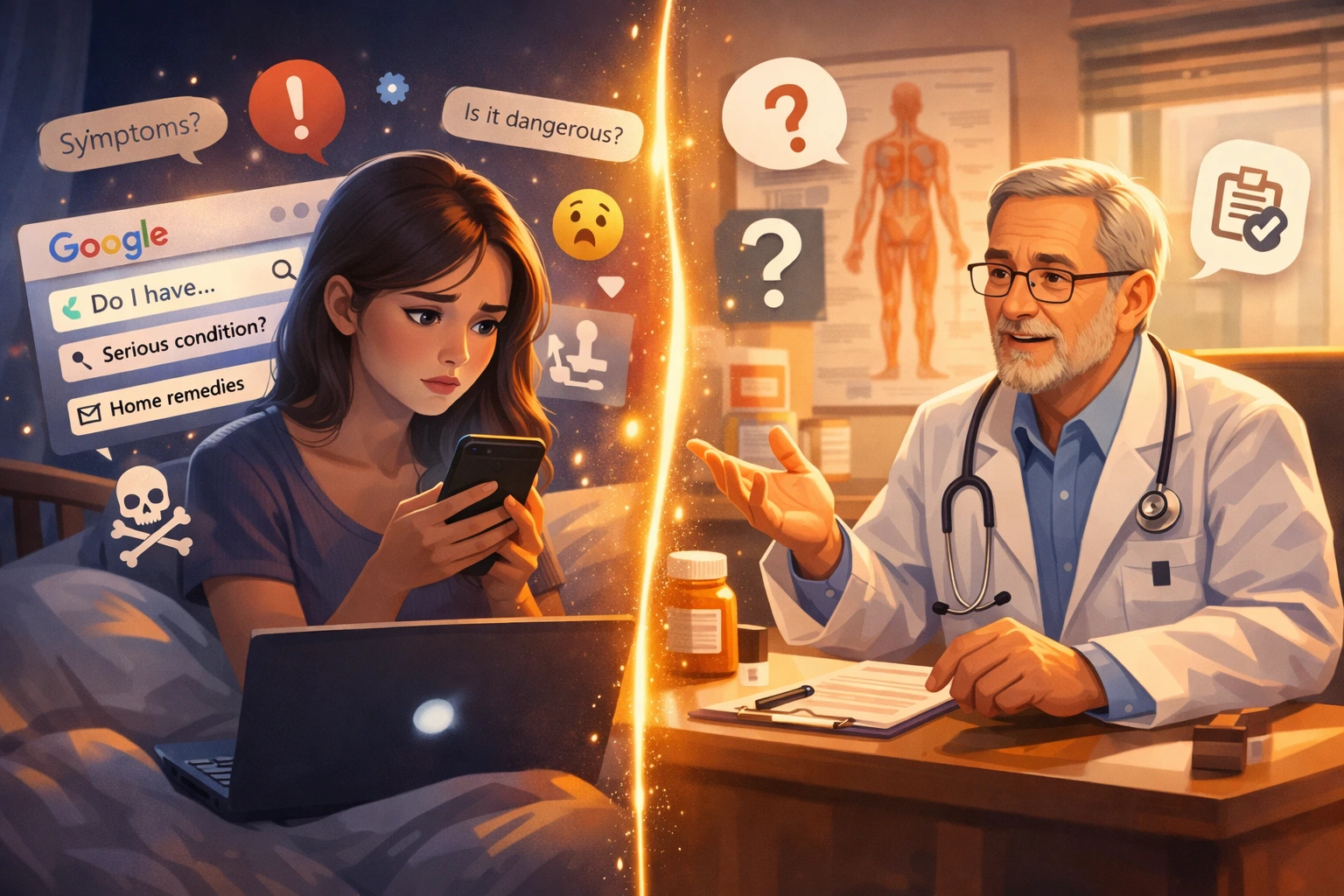
A strange pain shows up, nothing dramatic, just odd enough to be annoying. You tell yourself you’ll ignore it. Five minutes later, your phone is already in your hand. You haven’t called a doctor. You haven’t even finished worrying yet. You’re Googling.
And here’s the uncomfortable part: sometimes, we trust what we read there more than what a doctor later tells us.
That sounds reckless when said out loud. Yet it keeps happening, quietly, in bedrooms at midnight, on office chairs during lunch breaks, and in the back seats of cars while waiting for someone else. Why?
Table of Contents
What This Actually Looks Like in Real Life
This isn’t about people thinking doctors are useless. Most of us still respect them. We still show up to appointments, still nod along, still take prescriptions. But there’s a shift in how authority feels.
Picture this. You have recurring headaches. You Google it and find dozens of people describing the exact same pain. Same spot. Same time of day. Same triggers. Someone even mentions coffee helping, which oddly enough works for you too. By the time you see a doctor, you already feel like you “know” your problem.
Or take skin issues. A small rash appears. Google shows images. Reddit threads. Before-and-after photos. Someone posts a routine with products you can buy nearby. The doctor later gives you a quick diagnosis and a cream, but you’re already halfway convinced by the stranger online who posted photos over six months.
Then there’s parenting. New parents Google everything. Fever temperatures. Sleep cycles. Feeding schedules. Sometimes they trust a parenting forum more than a pediatrician who has five minutes per patient. That’s not rebellion. That’s filling a gap.
Google doesn’t feel distant. It feels personal.
The Immediate Everyday Impact
The first effect is subtle. It’s not dramatic distrust. It’s second-guessing.
A doctor says, “It’s nothing serious.”
Google says, “It could be one of five things.”
Suddenly, “nothing serious” feels incomplete.
People start asking more questions. Some stop following advice fully. Others delay appointments because they think they already understand the issue. You see it with lifestyle changes too. Someone decides to manage blood sugar with diet tips they found online instead of following a structured medical plan. Not because they hate doctors, but because the internet spoke their language.
There’s also speed. Google answers immediately. No waiting room. No awkward explanations. No fear of sounding silly. You can ask Google the dumbest question imaginable, and it won’t raise an eyebrow. That matters more than we admit.
Another everyday change? People come to doctors not for answers, but for confirmation. The appointment becomes a fact-checking session. “I read that this could be vitamin deficiency. Is that true?” The power balance quietly shifts.
Sometimes that’s helpful. Sometimes it’s not.
Why Google Feels More Trustworthy Than It Should
It Never Talks Down to You
Doctors are human. Some are tired. Some are rushed. Some explain things brilliantly, others don’t. Google, on the other hand, always meets you where you are. You search in your own words. It responds in a thousand tones until you find one that fits.
Feeling scared? You’ll find reassurance. Feeling curious? You’ll find deep dives. Feeling suspicious? There’s content for that too.
That flexibility creates comfort, and comfort easily turns into trust.
Shared Experience Feels Like Proof
When ten people online say, “I had this exact symptom and this worked,” it feels powerful. More powerful than statistics, sometimes. A doctor might say, “In most cases…” but the internet says, “Here’s my story.” Stories stick.
That’s why people trust reviews over ads, and strangers over brochures. Health is no different.
Control Feels Safer Than Authority
Doctors represent systems. Hospitals, rules, costs, time limits. Google represents choice. You decide what to read, what to believe, what to ignore. That sense of control is calming, especially when your body feels unpredictable.
Ironically, the less control we have over our health, the more we cling to the illusion of understanding it.
Bigger Social and Long-Term Effects
Zoom out, and this isn’t just about individual searches.
Doctors now spend time correcting misinformation before treating the actual problem. Some patients refuse vaccines or medications because something they read “didn’t feel right.” Others push for tests they don’t need, driven by online anxiety rather than symptoms.
Healthcare systems feel the strain. Appointments take longer. Trust becomes fragile. And when trust weakens, outcomes often follow.
There’s also inequality baked into this shift. People who are good at searching, reading, and filtering information gain an advantage. Others drown in conflicting advice. Google doesn’t warn you when you’ve gone down a misleading path. It just keeps walking with you.
And yet, there’s a flip side. Patients are more informed than ever. Rare conditions get noticed earlier. Misdiagnoses get challenged. Some lives are genuinely improved because someone Googled at the right time.
The problem isn’t access to information. It’s knowing when to stop scrolling.
The Limits We Don’t Like to Admit
Google doesn’t examine you. It doesn’t hear your breathing. It doesn’t notice the small pause before you answer a question. Doctors do.
Search results also don’t carry responsibility. If advice goes wrong, the internet shrugs. Doctors, on the other hand, live with consequences. That weight changes how decisions are made.
And while the internet feels unbiased, it’s shaped by algorithms, trends, and sometimes outright nonsense. The loudest advice isn’t always the best advice. It’s just the most clickable.
There’s another uncomfortable truth: we often trust Google more when we don’t like what the doctor says. If the advice requires effort, patience, or lifestyle changes, we go looking for easier answers. The internet usually provides one.
That’s not wisdom. That’s human nature.
A Thought Worth Sitting With
Maybe this isn’t about choosing Google over doctors. Maybe it’s about what people are actually looking for.
They want time. They want explanations that make sense. They want to feel heard. Google offers the feeling of all three, even when the substance falls short.
So the real question isn’t “Why do we trust Google more?”
It’s “Why doesn’t the medical system always feel trustworthy enough on its own?”
The answer to that matters more than any search result ever will.