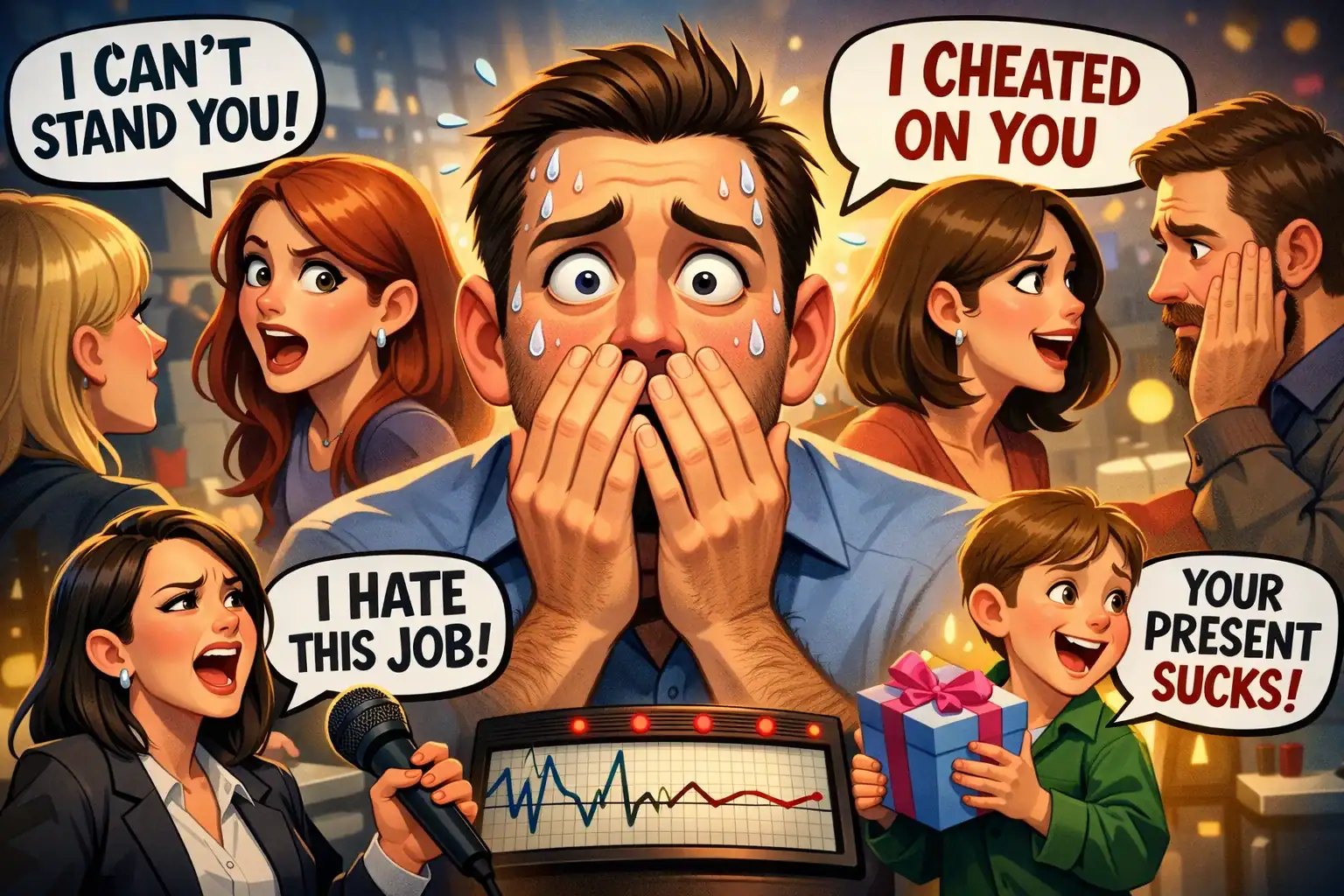
Think about the last time you said “I’m fine” when you weren’t. That small, almost automatic response — that’s the one. That’s where everything starts.
Lying is so woven into daily human behavior that most people don’t even notice it happening. Researchers have estimated that the average person tells somewhere between one and two lies every single day. Some studies put that number even higher. We lie to protect feelings, avoid awkward conversations, gain advantages, and sometimes just to get through the morning without conflict. It’s practically a social lubricant.
So what happens when you remove it entirely? Not reduce it — remove it. What if the human brain simply could not produce a false statement? No white lies, no exaggerations, no “the traffic was terrible” when you actually overslept.
The answer is both fascinating and deeply uncomfortable.
Your Everyday Life Would Change Before Anything Else
People tend to imagine the big stuff first — politicians confessing crimes, corporations admitting fraud. That’s fun to picture. But the first disruption would happen at breakfast.
“Do you like my cooking?” Suddenly, that question has stakes.
Or imagine a job interview where the candidate cannot say they’re “a people person” if they genuinely aren’t. The interviewer, for their part, cannot pretend the salary is “competitive” when it’s clearly not. Both sides, for once, would have to actually negotiate in reality.
Office life would transform almost overnight. The polite “we’ll keep your resume on file” disappears. So does “let’s circle back on that.” The things people say to move through the day without friction — gone. Replaced by what, exactly? Silence? Bluntness? A lot of awkward pauses, probably.
Even compliments would become suspect. If someone tells you your work is good, you’d know, for absolute certainty, that they mean it. That sounds nice until you realize how rarely it would actually happen.
Relationships Would Get Complicated Fast
Here’s where it gets genuinely interesting.
Romantic relationships run partly on carefully managed truth. Not lies, exactly, but selective honesty. You don’t always say what you think about your partner’s friend, their career decision, or what they’re wearing. That’s not deception for selfish gain — it’s navigation. It’s choosing what to say and when.
Strip that away, and couples would have to develop real tolerance for uncomfortable honesty. Or they’d fight constantly. Probably both, in phases.
Friendships work similarly. The friend who tactfully doesn’t mention that your new business idea sounds shaky — they’re not lying to you, but they’re softening the delivery. Without that option, every opinion becomes a potential grenade. You’d either become very thick-skinned very fast, or you’d start spending time only with people whose unfiltered thoughts you can actually handle.
There’s a strange upside, though. Manipulation becomes nearly impossible. Gaslighting — that particularly cruel form of psychological abuse where someone makes you doubt your own perception of reality — would effectively cease to exist. Every abusive dynamic that depends on deception would collapse. That’s not a small thing.
Society and Politics Would Look Nothing Like Today
Now for the bigger picture.
Political campaigns as we know them would be finished. Not reformed — finished. A candidate who cannot promise things they don’t intend to deliver, cannot exaggerate their record, and cannot pretend to care about issues they privately dismiss would have to run on something genuinely different. What that looks like, nobody really knows. It might be refreshing. It might be terrifying.
Advertising would have to completely reinvent itself. “The best burger in the world” becomes illegal not just by consumer protection standards, but by the laws of human biology. Brands would have to say what they actually offer. Honestly, some of them might do fine. Others would quietly disappear.
The legal system would change in strange ways too. Witness testimony, already imperfect, would become completely reliable — which sounds ideal until you realize that memory itself is not a recording. People can sincerely believe false things. You can’t lie, but you can still be wrong. Courts would have to reckon with the difference between honest testimony and accurate testimony, which is a very real and underappreciated distinction.
The Counterpoints Worth Taking Seriously
It would be easy to paint this as pure utopia. It isn’t.
Some lies serve important functions that we rarely acknowledge honestly. The doctor who tells a terminally ill patient they have “a few months” when the real answer is “we genuinely don’t know” — that softening is partly compassion. The parent who tells a frightened child that everything will be okay — that’s not manipulation, it’s comfort, and comfort matters.
Diplomacy would essentially stop functioning. International relations depend, to an alarming degree, on strategic ambiguity. When you remove the ability to say things that aren’t quite true, you also remove the ability to say things that aren’t quite anything — the carefully crafted statements that keep negotiations alive. Some conflicts persist because they’re never fully resolved, and everyone quietly agrees to keep talking. Take that away, and some of those conversations end very badly.
There’s also the question of privacy. Not lying doesn’t mean being forced to speak. You can stay silent. But in a world where silence itself becomes a kind of signal — where people know that if you had something positive to say, you would have said it — silence starts to mean something very specific. That’s a different kind of pressure.
What This Really Reveals About Us
The most unsettling part of this thought experiment isn’t imagining a world without lies. It’s realizing how much of our current world depends on them.
Not in a cynical way, necessarily. Some of it is kindness. Some of it is practicality. Some of it is the simple fact that human beings are complicated, and we’ve built social systems that accommodate complication rather than demand perfection.
A world without lying would be honest, yes. But it would also be a world where people have to be genuinely better at handling truth — their own and everyone else’s. That’s a skill most of us are still working on, quietly, imperfectly, and sometimes unsuccessfully.
Which raises the question that tends to linger: if we were suddenly unable to lie, would we become more honest people? Or would we just become people who have stopped talking?
The fact that the answer isn’t obvious says quite a lot about us already.
There’s a version of this world that sounds wonderful. There’s another version that sounds exhausting. The most likely version? Probably somewhere in the middle — more real, less comfortable, and occasionally, unexpectedly kind.